
The Esoteric History of Our Universe
An Interpretation of the Notes of E.I. Roerich
Presented here is a brief history of our universe, reconstructed on the basis of E. I. Roerich’s notebook records from 1948 to 1955. The records of E. I. Roerich that pertain to the description of the evolution of the universe do not form a continuous or strictly sequential narrative. Rather, they resemble the work of a sculptor who, at various stages of creation, applies the chisel to entirely different parts of the figure. Given the fragmentary nature of these records and the inherent complexity of the evolutionary process, the interpretation offered here does not claim complete accuracy. Nevertheless, it represents, at the very least, a possible course of events that is consistent with the available notes.
Pre-manvantara period
The history of our universe begins with the moment when the Unmanifested Sun initiates the birth of the Primary Sun[1]. The Primary Sun is a dense copy (reflection) of the Unmanifested Sun on the Manasic and Subtle planes. The beginning and the details of this process are unknown; however, it is known that this event occurred in the previous universe and resulted in the manifestation of the Primordial Atom of our universe within the core of the Primary Sun.
The term “universe” is understood as an inhabited region of space. This region is inhabited by spirits brought into manifestation by the Primordial Atom of a particular universe. The rank of the Atom corresponds to the scale of the region of space inhabited by It. Our universe is bounded by the constellations of the Zodiacal Circle. The most distant star of our universe is referred to as the Pole Star. The center of our universe is the Solar System and our Sun. Our Sun is a dense copy (reflection) of the Primary Sun on the Physical Plane. At the present time, the Primary Sun is located in the direction of the constellation of Hercules.
The Primordial Atom of the universe represents a union of two opposing and mutually complementary Poles (Principles or Vibrations). These are the positive, repulsive Father Principle and the negative, attractive Mother Principle. The Father Principle corresponds to electricity, progressive motion, and the Sun. The Mother Principle corresponds to magnetism, rotational motion, and the Moon of the Sun. The unmanifested state of the Primordial Atom during Pralaya corresponds to Its neutrality, or non-interaction with the surrounding environment.
The prenatal stage of the universe consists in the manifestation of the Primordial Atom of the universe within the core of the Primary Sun, that is, in Its activation, polarization, and rotation by the rays of the Unmanifested Sun. As a result of vibrational sympathy, atoms of a lower rank from the previous universe, consonant with It in vibration, are incorporated into the outer, Maternal sheath of the Atom on the Unmanifested Plane; from these atoms the future universe will be formed and populated. In other words, the manifested universe represents the body of the Primordial Atom.
It is likely that the self-consciousness of the Primordial Atom is something far greater than the combined consciousness of Its Father Principle and Mother Principle. The self-consciousness of these Principles corresponds to Its subconscious processes (habits, behavioral patterns, preferences, and modes of thinking) and to the energies of the Pingala and Ida channels in the human being. Moreover, the consciousness of the Mother Principle correlates rather with the slow, “corporeal” subconscious vibrations of the Atom, whereas the consciousness of the Father Principle is associated with the fastest “spiritual” vibrations that constitute the subconscious spectrum of the Atom.
The consciousness of the Atom, asleep during Pralaya, exists on the Unmanifested Plane and is, for the most part, the consciousness of the more active Father Principle.
The emergence of the self-consciousness of the Atom corresponds to Its awakening and manifestation. Manifestation, in turn, corresponds to the loss of neutrality through the birth within the Atom of the Third Pole (Son or Daughter). It is possible that the consciousness of the Third Principle corresponds to the subconscious energy of the Sushumna channel in the human being and is, to a significant degree, associated with the mainstream, or primary pattern, of the subconscious of the Atom.
As a result of the active union of the harmonious and resonating vibrations of the Father and the Mother at the awakening of the Atom, the Atom explodes in a Cosmic orgasm and gives birth to a Son in the case of an emerging masculine universe, or to a Daughter in the case of an emerging feminine universe.
The dual, neutral Cosmic Primordial Atom of our universe, after its first explosion, was transformed into a polar (masculine) triadic Cosmic Atma, corresponding to the Atma of a man.
The focus of the self-consciousness of our masculine Cosmic Individuality (the manifested universe) is the Atman (the Unknown Father), which gathers into unity the energies of the Trinity of the Cosmic Atma. The question of whether the Atman of the Cosmic Atma is the same atman as that of any human atma most likely does not have an unambiguous answer.
The question of the location and destiny of the polar opposite (the vibrational complement) of our Cosmic Individuality also remains open. Most likely, analogous to the Mother Principle within the Primordial Atom, this feminine Cosmic Atma, together with our masculine Cosmic Atma, on the highest Unmanifested Planes constitutes a Cosmic Atom of an even more magnificent scale than the Primordial Atom of our universe.
Analogously to the cosmic ones, human masculine and feminine atmas are halves of human atoms on the Unmanifested plane and the seeds of spirit for their denser manasic sheaths—the masculine and feminine monads. Only in the case of attaining spiritual union with one’s own half before the onset of the period of pralaya is further evolution together with it in the next manvantara guaranteed. Otherwise, the halves meet only for the duration of a manvantara, after which they are reassembled before a new manvantara into more successful combinations (atoms). During a manvantara, the human atom is unified on the Atmic, Unmanifested plane. But on the Manasic plane, the monads composing the human atom represent the manasic halves of the atom, which are sometimes separated from one another by immense distances.
It is important to note that in this case the term “Manvantara” refers to the global period of the entire manifestation of the universe following the period of pralaya and the explosion of the Primordial Atom. In the general sense (and further in the text), manvantaras are often used to denote smaller periods of time within a single manifested universe, for example, periods between changes of the central luminaries of the universe, evolutionary phases of development, and changes in the relationships between the Principles of the Atom. Such ambiguity leads to confusion and often to the impossibility of correctly interpreting fragmentary records without an understanding of the context.
The realization of the necessity, in one’s life, of finding one’s polar Opposite in order to achieve the best conditions for mutual development and to bring the greatest benefit to oneself, one’s other Half, and the World is an important evolutionary stage for developed men and women.
Prior to its first explosion, the Primordial Atom has, as its inner, Paternal sphere of the Primary Sun, the sphere of Uranus, and as its outer, Maternal sphere, the sphere of the Moon of Uranus. The Maternal sphere is magnetically connected with a Moon-comet that moves along the orbit closest to the Primary Sun on the Unmanifested plane. The motion of the Moon-comet within the Maternal sphere around the Paternal sphere of the Primary Sun corresponds to the motion of the Atmic seed of the Mother around the seed of the Father within the Atom. The union of the seeds of the cosmic Atom is analogous to a proton–electron pair in the hydrogen atom, though an even more accurate comparison is with a particle composed of a particle–antiparticle pair. The birth of the Son in the neutral Atom is analogous to the formation of a positive proton consisting of two masculine up quarks and one feminine down quark. Thus, the proton is an analogy of the manifested Primordial Atom (Atma) of our universe.
First manvantara
As a result of the first explosion of the Atom, the dual atoms of the previous universe emerge (are born) into manifestation, receiving an impulse from the Father (Uranus, the inner sphere of the Primary Sun) and being clothed in the finest matter of the Mother (the Moon-comet, the outer sphere of the Primary Sun). This period constitutes the manvantara of the Primary Sun. The first and densest sphere of the Primary Sun formed during this manvantara is the sphere of the Son (Saturn). The true name of the Primary Sun is not revealed, but when referring to that distant period, it is sometimes mentioned by the name Saturn. Subsequently, from the spheres of the Father and Mother, the sphere of Sirius and its moon (the Mother Moon) are formed. This is likely why the Primary Sun is often also called Sirius, although Sirius as an independent luminary separates from the Primary Sun only after the third explosion of the Atom.
During the manvantara of the Primary Sun, the Manasic seeds of the Father, Mother, and Son are formed in the core of the sphere of Sirius. The manvantara of the Primary Sun is the manvantara of genesis and is often attributed to the pre-manvantara period, and Uranus is sometimes called the first Sun of the universe.
The Primary Sun Sirius represented a triune conscious Being (Atman, whose body was the Atma), not human but beautiful in appearance, which exploded (the first explosion of Sirius, the second explosion of the Atom) shortly after it had established its orbit around the Unmanifested Sun.
After the first explosion of the Atom, the Atmic Pole of the Mother remained inseparable from the Atmic Pole of the Father in the sphere of Uranus of the Primary Sun. However, the Atmic and Manasic Pole of the Son was strongly connected with the then most densified Manasic sphere of Saturn, where the complementary feminine Atmic Pole did not exist. The Manasic seeds of the Trinity formed a single Manasic body of the Atman only within the sphere of Sirius. The unified Atmic body of the Trinity in the Unmanifested sphere of the Atman of the Primary Sun, common to all Principles, was probably not sufficiently well-formed due to the strong connection of the Atmic seed of the Son with the sphere of Saturn. The Manasic Principles of the Father and the Son within the Atma were firmly connected by the Mother. This type of connection is characteristic of the strongest crystals, in which neighboring positive atomic nuclei are bound by a shared negative electron. Nevertheless, the absence of the feminine Pole in the sphere of Saturn caused excessive disturbance of the Son and internal tension within the Atom, resulting in His explosion together with the Primary Sun (the first explosion of Sirius, the second explosion of the Atom).
The question of the location of the complementary feminine Half of the Son remains open. The role of the Son’s complementary Half in the Atma is played by the Mother. The likely cause of the dramatic nature of the evolution of our universe was the Son’s excessive and selfish attraction to the Mother. The beginning of the mortal rivalry of the Son with the Father over the Mother—sometimes subsiding, sometimes flaring up with renewed intensity—was set in motion by the first explosion of the Primary Sun Sirius.
The first explosion of Sirius (the second explosion of the Atom) is often called the beginning of the universe and the beginning of the First manvantara. The First manvantara is usually referred to as the manvantara of Sirius, although during this period the three Suns held central positions in the Solar System: the Primary Sun Sirius, Saturn, and Uranus.
As a result of the first explosion of the Primary Sun Sirius, many world cores were born, in particular, the cores of Venus, Jupiter, and the Best Planet. The sphere of the Mother Moon separated from the Primary Sun Sirius after the explosion as an independent planet, but it did not move away from Sirius; instead, it took the orbit closest to Him. This event corresponded to a certain separation of the Mother’s Pole from the Father’s Pole in the Atom on the Manasic plane. After the first explosion of Sirius, the Monolithic Manasic body of the Trinity partially disintegrated due to the separation of the Manasic seed of the Son, and the neutral human monads became polarized into androgynous beings. As a result of the explosion, the seed of the Son flew from the core of Sirius into the core of Saturn. Saturn thereby separated from the Primary Sun Sirius as an independent luminary. In the core of the sphere of Sirius, only the Ray of the Son remained, by which He continued to be connected with the Mother. Along with the seed of the Son, a vast portion of the Fohatic energy of Sirius passed into Saturn.
After the first explosion of the Primary Sun Sirius, Uranus initially occupied the central position, but was soon displaced by Saturn. The Mother Moon did not move to Saturn but remained in orbit around Sirius. This period of the First manvantara can be described as a cooperation between Saturn and Uranus within the cosmos of Sirius. At that time, Saturn was unable to establish itself in its manvantara due to a lack of the Moon, and it was displaced by Uranus as soon as the Mother Moon became the Moon of Uranus (the seed of the Father then passed into Uranus).
After some time, the Son’s attraction to the Mother caused the second explosion of the Primary Sun Sirius (the third explosion of the Atom). As a result of the explosion, the Mother separated from the Father on the Manasic plane, and the Ray of the Son left the core of Sirius. The seed of the Father simultaneously flew from the core of Sirius into the core of Uranus. Uranus immediately exploded, giving rise to Neptune, in the core of which the Manasic seed of Lord Kut-Humi appeared, but, for a mysterious reason, without His polar opposite. In addition, as a result of the explosion of Uranus, a small Moon of Uranus was born, in the core of which the Manasic seed of Lady Bhong-Po (Oriola) appeared. The explosion carried the masculine Half of the Lady to a distance inaccessible to Her. Human monads were divided as a result of the explosion. Many Manasic halves of atoms were scattered by the explosion across different luminaries of the universe. During that period, husband and wife remained connected by an energetic channel corresponding to a rib in the body of the husband on his right side.
The sphere of Sirius separated from the Primary Sun as an independent luminary (the second explosion of the Primary Sun Sirius). In this process, Uranus and Saturn materialized (densified) from fragments of the sphere of Sirius. Shortly thereafter, Saturn exploded and moved to the periphery of Uranus’s Solar System. Sirius also moved to the periphery and began to break up into smaller luminaries and planets.
During this period of the First manvantara, the beginning of the self-conscious evolution of men and women physically connected to each other was established. The evolution of the First manvantara occurs on the Mental plane. The Father and Mother create the cores of worlds, incarnate as elemental Spirits of Fire and Air, and begin the formation of refined humans on the Mother Moon. The fire of Uranus exceeds the air of His Moon, and the element of Air gradually burns out on it. Uranus is forced to surround Himself with new, often unsuitable Moons, but the Mother Moon remains the senior Moon.
At this time, Saturn returns from the periphery, accompanied by numerous Moons, while the Primary Sun begins to move into the higher spheres and beyond the Solar System. Uranus and Neptune, strongly connected with the Primary Sun, move along with it. Following Uranus, its small Moon and the Best Planet move into the higher spheres and to the periphery of the system; the Best Planet will become the most developed planet in the Second manvantara. The Mother Moon cooperates briefly with Neptune and then moves to Saturn. Saturn assumes the central position and establishes itself in its manvantara at the end of the more extensive First manvantara. During this period, the Father loses His Tara.
The Son and the Mother create the worlds of Mars, Mercury, Venus, the Best Planet drawn to Saturn, the small Moon, and other planets. Yet on all the worlds they form rests the seal of the Mother’s indifference. In the rays of Saturn, the sheaths are densified and human intellect develops. The Hierarchy of the Son is established. The Son and the Mother are Spirits from densified Mental matter, slightly oscillating with atmospheric movements.
Soon, Uranus, resplendent and renewed in the higher planes, and his brother Neptune return. The Mother Moon returns to Uranus. The small Moon becomes a satellite of the Mother Moon. Thanks to its union with the Mother Moon, the masculine power of Uranus further increases, and he displaces Saturn from the center. Both luminaries explode, and Saturn moves to the periphery of the Solar System of the renewed Uranus.
Second manvantara
The next, Second manvantara is characterized by the highest development of life on the Best Planet and the predominance of the vibration of the Feminine Principle in the evolution of the Cosmos. The Mother Moon, together with the small Moon, moves toward the Polar Star due to the Mother’s decision to appear with the Father on the Best Planet, which becomes the Moon of Uranus. To replace the fatigued Uranus, the Father summons our Sun into the Solar System. Our Sun comes from the region of the Zodiac that at that time was occupied by Hercules, and is now Scorpio. Our Sun comes together with Saturn and does not allow it to occupy the central position in the Solar System. A system of three Suns is established: Uranus, Saturn, and the Sun. Uranus predominates. Saturn returns, accompanied by numerous Moons. In the fiery vortex of the Sun, from a fragment of the Moon-comet brought from the constellation of Hercules, our Moon is materialized, which becomes the Moon of the Sun. From the constellation Orion, a waning Sun—our Earth—is drawn into the system of the three Suns. The Best Planet becomes the Moon of our Sun, and the Father assimilates its energies.
On the Best Planet, the most favorable conditions for the development of humanity and the Kingdom of the Three arise. The Mother occupies the leading position and, like the other women of the Best Planet, has several husbands. The principal husband is the Father. On the Best Planet, the Hierarchy of the Father is formed and the Stronghold of Knowledge is established. In the rays of our Sun and Saturn, and also through the efforts of the Son, a strong densification of the human subtle body occurs, almost to the state of physical density. A skeleton and muscular system appear. A rupture occurs between awareness in the incarnated state (in the densified body) and awareness in the disincarnated state (in the subtle body). On the higher planes of the Subtle world, the Father and the Mother create worlds, but in the densified state They lose awareness of Their inner Essence. At the Mother’s wish, the Father conceives within Her a new type of human organism, in which no bond arises between husband and wife from the right rib of the husband. Soon thereafter, on the Best Planet, a complete mixing of the half-monads occurs and a decline of morals ensues.
Third manvantara
The Third manvantara is the manvantara of the battle between Saturn and Uranus for the Best Planet. Saturn approaches the Best Planet and establishes itself at the center of the system of three Suns. On the planets of the system, from seeds brought by our then still young Sun, monstrous forms of physically primitive humanity develop. On Earth, during this time, the cycle of the Third Root Race of humanity comes to an end.
Formally, the traditions of matriarchy and the Kingdom of the Three continue on the Best Planet. However, soon the Son intends to seize the Mother and the Best Planet into his sole possession. The Father refuses to cooperate with the Son. The Mother virtually withdraws from the Father and becomes the sole wife of the Son, who possesses more than a thousand concubines. The Father limits himself to only a few advanced wives. Possession of the Mother grants the Son an advantage in Power, yet the Power of the Father becomes equal to that of the Son. The moral decline on the planet reaches the stage of debauchery and orgies of black magic. A struggle begins between the followers of the Father and the Son. Saturn begins to fade, while Uranus rises and displaces Saturn from the center of the system.
In order to destroy the Father’s palace on the Best Planet, the Son draws from space an enormous poisonous bolide. In response, the Father finds in space a small but extremely powerful bolide with which he intends to destroy the Son’s bolide. The Father warns the Mother of the impending collision and offers her shelter with him in his laboratory. The Mother categorically refuses to do so without the Son. The Father agrees. But the Son puts forward his condition: he agrees to take refuge with the Father and the Mother in the Father’s laboratory on the condition that if his bolide proves stronger than the Father’s bolide, the Father must renounce the Mother. The Father agrees again. As a result, the Father’s bolide destroys not only the Son’s bolide but also splits the core of the planet. The Best Planet explodes. A huge fragment of the Best Planet, which in the future will take form as the New Best Planet, is carried off in the direction of the constellation Hercules. The Father transfers the Mother, the Son, the Brothers with their Halves, and a small number of his followers in the rays of Uranus to Mars. The Son leaves the Father and the Mother and moves to the periphery of Saturn’s Solar System. The small Moon of Uranus begins to fade.
The second half of the Third manvantara is the manvantara of Uranus and the Kingdom of the Beast. The Father and the Mother incarnate on Mars as Gods, Messengers, and leaders. Soon the Son joins Them. New offspring arise from the Father and the Son. The Mother withdraws from the Son to the Father, and Uranus displaces Saturn from the center of the Solar System. But the Son persecutes the Mother and the Father, repeatedly subjecting Them to cruel tortures and executions. The struggle between the Father and the Son for the Mother continues on our Moon and on Venus. On the Moon, the Mother incarnates as the Goddess of the Lunar cult, while the Father and the Son incarnate as leaders of warring states. At this time, the densified etheric bodies of Earth’s inhabitants separate, and optimal conditions for the development of intellect are created on Earth. Soon the Son seizes the Earth, and then Spirits of the Fiery Mist—former inhabitants of the Best Planet—arrive there from Venus. Uranus fades, and our Sun occupies the central position in the Solar System.
Fourth manvantara
The Fourth manvantara (the one contemporary with us) begins with the densification on Earth of the Subtle bodies of the Spirits of the Fiery Mist almost to the point of tangibility. These Spirits form their bodies by the power of kriyashakti. Soon they, as well as the Spirits from the Moon and Mars, begin to incarnate (fully or partially) into the bodies of primitive, yet already fully self-conscious humans. A significant improvement of the human type takes place, but the human being is born in almost complete oblivion of past lives and of their inner Essence.
In order to hinder the spiritual evolution of Earth’s humanity, oppose the universal Solar Hierarchy of the Father, and remove the Earth from the evolutionary path of the Solar System, the Son erects a dense veil around the physical plane of the Earth, which obstructs the penetration of the higher emanations of the Cosmos. By this time, the Earth becomes the most intellectually developed and a very significant planet of our universe, although inferior to some planets in spiritual development. The Father and the Mother decide to enter into struggle with the Son on the physical plane of the Earth, for the sake of saving not only the planet but the entire universe. To this end, They begin to incarnate together with Their spiritual family (constituting the Solar Hierarchy of our universe) as Rulers, Sages, and Teachers of Earth’s humanity. Magic among people rapidly divides into the Left-hand and Right-hand paths, and the majority rush along the easier but dead-end Left-hand path. In the progeny of the Son, black magicians predominate.
On the higher subtle planes, the Mother creates together with the Father, but on the lower planes She is still bound to the Son. A bolide from Orion, magnetized by the Father to the Earth to save His country from the Flood in the Fourth Root Race of humanity, scorches the Mother (Uodeo) on the Island in Atlantis and significantly purifies Her lower sheaths from the bond with the Son.
The legends of Isis, Osiris, and Set, of the abduction of Sita by Ravana and of Rama’s battle with him for his Chosen One, are poetic memories of humanity about the dramatic rivalry of the Father and the Mother of the universe with Their spiritually fallen Son on the planet Earth.
In the Fifth Root Race, the struggle of the Father with the Son on Earth continues. The Son holds an advantage in Black Magic on the Physical and lower Subtle Planes, but is unable to oppose the Father on the higher planes. By exploiting the connection of the sexual centers with the head centers, he develops his own intellect and that of his followers at the expense of spirituality. Most of his followers are his own progeny. The most gifted among them are his offspring from the Mother.
The Father and the Brothers, the eldest of whom is the Teacher Kut-Humi, establish in the Himalayas a Stronghold of Knowledge and resistance to evil. The Teachers themselves continue to incarnate as Sages, Guides, and Rulers in order to oppose the corruption of humanity and the destruction of the Earth.
Of great significance was the incarnation of Kut-Humi as Jesus Christ, who accepted the mission of the World Teacher, but as a result of selfless struggle and excessive expenditure of energy fell mortally ill. Jesus called to Himself the Father, who at that time had been born on Earth of the Mother and was the elder Friend and earthly Mentor of Jesus. The Father came to Jesus when He was already on His deathbed. They spoke and resolved upon an experiment dangerous for the Father. Jesus joyfully agreed to offer His dying body to the Father. The Father died in His already aging body and incarnated into the mortally ill body of the thirty-year-old Jesus. Soon He overcame the illness and took upon Himself the mission of the World Savior. The Father gathered Disciples and began to preach. His closest Disciple was the Mother, then incarnated in the body of the young Mary Magdalene. Mary recorded the teachings of Christ not only during His lifetime, but also after His Departure. The records were kept by John, and from them the Gospels and the teachings of the Gnostics were compiled.
By the end of the nineteenth century, the victory of the Father and the Mother over the fallen Son (Lucifer) became possible only on the condition that They attain Full Arhatship on Earth. Full Arhatship had until that time been unattainable on Earth and signified the union, on the earthly plane, of the half-monads of man and woman in three principles (Manas, Buddhi, Atma) and in three bodies (Physical, Subtle, and Spiritual).
As a result of the Son’s efforts and the mistake of one of the Brothers, the possibility of the Mother’s next birth in an earthly body was blocked. Nevertheless, through the efforts of the Father and the entire Brotherhood, the Mother managed to incarnate in the body, distorted by the Son, of a girl dying of illness at the age of seven. The girl’s name was Helena Roerich. She died, and the Mother incarnated in her body.
In her childhood, with the help of the Father, Helena Ivanovna managed to overcome her illness; in her youth, she significantly corrected the damage inflicted on her nervous system and heart; and in old age, she underwent the fiery transmutation of the centers, the separation of the three principles, and attained on Earth the level of Full Arhatship together with the Father. Yet the price of this achievement was high. The sheath of the passionate double, the etheric double itself, and largely the sheath of the mental body were consumed as a result of the fires of the centers. The most significant fire occurred during the expedition to Tibet, in the smoke of Mongolian bonfires.
As a result of the burning away of the densified layers of the Manasic sheath, the Mother lost the possibility of earthly incarnation in a human body of the modern type. The layer of the Mother’s Manasic sheath corresponding to the Subtle Body (Kama-Manas) was replaced with the Father’s lucid matter. This grants the Mother the possibility of manifesting on the earthly plane together with the Father in human bodies of a new type in the second half of our century. The new human bodies, formed of densified astral substance, possess tangibility and the ability to fly on the earthly plane. The burning away of the lower layers of Elena Ivanovna’s Manasic sheath substantially facilitated the Father’s protection of the Mother from the Son on the Subtle Plane and increased the chances of victory over Him in the final and decisive battle.
In the 1920s of the previous century, the Mother Moon (the Planet of the Mother of the World), existing on the etheric planes, and the Small Moon (the star of the Mother of the World, visible as a comet) on the Physical plane approached the Solar System. The Mother Moon was protected from the Son and His followers, and an outpost of the Brotherhood was located there. However, in 1936 the Son succeeded in mastering a deadly cosmic ray, by means of which He captured the Mother Moon. In 1940–1941 He transferred His Stronghold there. Prior to this, the headquarters of the Son had been located on the far side of our Moon on the Subtle plane.
In 1949, the decisive duel took place between the Father, who had united His Power with the Magnetism of the Mother, and the Son on the Mother Moon. As a result, the Son’s deadly strike against the Father and Mother rebounded upon Him. The Son and His closest, most powerful followers were burned with all of their bodies except the Monad. Thus, they were deprived of the possibility of incarnation anywhere in the Solar System—not only in the ongoing Fourth manvantara, but also in the forthcoming Fifth. The Stronghold of evil on the Mother Moon was incinerated by the rebound along with the planet’s crust, and its core received a dangerous fissure. Through the efforts of the Brotherhood, the fissure in the core of the Mother Moon was healed.
The Brotherhood placed its hopes on the Mother Moon becoming a home for the main part of Earth’s humanity after a possible catastrophe on Earth in the 1950s of the previous century in the event of nuclear war, and in 1977 as a result of the union of the inner fire of the Earth with the outer fire of the Invisible Sun.
The Invisible Sun passes through the Solar System once every century. The catastrophe of 1977 was postponed to 2077 through the efforts of the Brotherhood to restrain the Earth’s inner fire, as well as owing to the destruction of many of the lower astral spheres of the Earth as a result of nuclear explosions. However, those same explosions also began to weaken the Earth’s protective barrier and led to the destruction of many beings, predominantly lower spirits.
Spirits caught in the epicenter of a nuclear explosion burn away all the densified layers of the Manasic sheath (the layers of the Double’s sheath and the Subtle Body) up to the Manasic layer corresponding to the Causal Body, and are deprived of the possibility of incarnation for a period of no less than one manvantara, depending on the damage inflicted upon the bodily sheaths.
After the crust of the Mother Moon was burned, this planet lost the ability to receive the main part of our humanity for hundreds of thousands of years, until the crust hardened and vegetation appeared on it.
In the 1950s, the magnetic calls of the Father and the Mother drew into the Solar System the New Best Planet—a gigantic fragment of the former Best Planet. However, this planet requires that the Father, the Mother, and the entire Brotherhood construct new spheres upon it, suitable for the main part of our humanity.
It is expected that the catastrophe of 2077 will not shatter the Earth, but will only lead to significant tectonic changes. The subsidence of continents will affect the territory of the former Soviet Union relatively little, which cannot be said of Western Europe, Australia, and the Americas. The catastrophe is meant to serve as a purifier of the Earth’s spheres and of the humanity dwelling within them.
Future manvantaras
The next, Fifth manvantara of humanity in our universe will unfold on the Subtle plane and will be the manvantara of Intellect. The prevailing cosmic vibration of the Fifth manvantara will be the vibration of the Feminine Principle. The Sun of the next manvantara will be Altair from the constellation Cygnus, which has already begun approaching the Solar System. The Father and the Mother will assimilate its energies.
The Sixth manvantara of god-like humanity will take place in worlds on the boundary of Buddhi and will be the manvantara of spiritual reasoning with equality of the Principles.
The brief Seventh manvantara will serve as preparation for the dreams of a new universe, possessing a wider spectrum of elements and possibilities for the development of the spirit.
Table of the manvantaric sequence
Table 1 presents the Manvantaric Sequence corresponding to the events described above. The first row lists the most commonly used names of the manvantaras. The second shows the luminaries that occupied the central position. The third indicates the predominant Principle.
The term “Manvantara” is ambiguous in the Primary Source [1] when applied to the precise duration of the reign of the Lord (Manu) of our universe. Supreme sovereignty of the universe is possible only in conjunction with the Lord and his Tara, and with the corresponding central luminary of the universe.
The “canonical” Hindu Naimittika Manvantara, as a period of manifestation between Naimittika Pralayas (that is, dissolutions of the worlds of form—planes below Manas), may be divided into seven still smaller periods of activity (minor manvantaras), corresponding to the periods of formation of the four predominantly Manasic layers of the Human being within a single minor evolutionary cycle (see Figs. 1 and 2 in the Explanations section), which together constitute the Naimittika Manvantara.
However, both the duration and even the number of these minor manvantaras are ambiguous, since there have been cases when, within a single minor manvantara, different luminaries (Sirius, Uranus, Saturn, the Sun) alternately occupied the center of the system. In this process, the luminary of the Son (Saturn) displaced the luminary of the Father (Uranus) from the central position in our minor universe, the most significant part of which is the present Solar System.
| Primary Sun(Saturn) | First (Sirius) | Second (Uranus) | Third (Saturn &Uranus) | Fourth (Sun) |
|---|---|---|---|---|
| Sun-Atom, Sun-Atma | Sirius, Uranus, Saturn | Uranus, Saturn, Sun | Saturn, Uranus, Sun | Sun |
| Equality of Principles | Male above Female | Female above Male | Equality of Principles | Male above Female |
The emergence from pralaya is unknown. The Manvantara of the Primary Sun (Saturn). The arising within the Primary Sun of the densest sheath of the Sun-Atma — the sphere of Saturn — through the unmanifest masculine sphere of the Sun-Atma (the sphere of Uranus, inherited from the Sun-Atom) and the Moon-Comet (from whose condensed matter our Moon later formed). The arising of the sphere of Sirius and the sphere of the Mother Moon (later a small planet near the Pole Star — the Planet of the Mother of the World). The fixing of the condensed, united Atmic seeds of the Father, Mother, and Son in the sphere of Sirius (the Paradise of Sirius). The Common Moon. |
The Manvantara of Sirius. The unrealized Manvantara of Saturn. Sirius — both a sphere and the name of the Primary Sun, the body of the Atman, a conscious Entity, not human yet beautiful, at the center of the system. A Trinity in one body. The first Consciousnesses in manifested forms. The sphere of the Mother Moon and the Moon-Comet — the wife of the sphere of Sirius. The second explosion of the nucleus of the Atom (the first explosion of the Primary Sun Sirius, spontaneous, immediately after it assumed the central position in the system — the principal explosion). The revelation of seven separated Primordial Atoms. Separation, but not a complete division of the Mother from the Father. Polarization of human atoms. Partial bodily separation of the Son from the body of the Trinity. Yet the Son remained the husband of the Mother, possessing a manasic ray within the body of the Trinity. By explosion, the separation and departure from the multilayered Primary Sun of the sphere of Saturn together with the seed and the fohatic force of the Son. The first explosion, revelation and partial separation from the Primary Sun of the sphere of Uranus with the ray of the Father. The explosion of the Moon-Comet and the flight of its fragment (our future Moon) into the depths of space. The explosion of the sphere of the Mother Moon. The separation of the sphere of the Mother Moon from the Primary Sun Sirius as an independent planet, which remained in the orbit of Sirius. The revelation of the nuclei of Jupiter, the Best Planet, and of the fragment of the Moon-Comet — Venus. The revelation of many suns and planets. The approach of Saturn. Its displacement of Uranus from the center. The Common Moon. The Manvantara of Uranus. Saturn — the co-ruler of Uranus in the cosmos of Sirius. The third explosion of the nucleus of the Atom (the second explosion of the Primary Sun Sirius), caused by the Son’s attraction to the Mother and by Saturn’s assumption of the central position. The cooperation of Uranus with the Mother Moon and with the nucleus of the future Best Planet. The displacement of Saturn from the center by Uranus. The Moon’s departure from Sirius toward Uranus. The explosion and separation of the sphere of Sirius from the Primary Sun. The separation of the halves of the monads from one another. Husband and wife remain energetically linked by a “rib” on the right side of the husband. “lost”. The ejection of the seed and the fohatic force of the Father from Sirius to Uranus, and of the ray of the Son to Saturn. The second explosion and the final separation of Uranus from the Primary Sun. By explosion, the release from Uranus of Neptune and a small Moon (the Star of the Mother of the World), and the formation of the nuclei of Mercury and Mars. The materialization of Saturn and Uranus from fragments of the sphere of Sirius. The second explosion of Saturn and its flight to the periphery. The withdrawal of Sirius to the periphery. The fragmentation of Sirius. The life of the Father and Mother as elemental spirits of fire and air on Uranus. The beginning of reincarnations. The evolution of the united (interlinked) Principles. The formation of a refined type of human on the Moon of Uranus. The Father and Mother create the nuclei of worlds. The fiery Uranus is surrounded by additional Moons, often unsuitable, due to the deficiency of the air element (for fiery Uranus) on the Mother Moon. The Mother Moon is the primary Moon. The return of Saturn surrounded by Moons. The departure of Uranus, together with Neptune, the nucleus of the future Best Planet, and the small Moon (Bhong Po, Oriola), into the higher spheres. The Manvantara of Saturn. Saturn at the center. The cooperation of the Mother and the Mother Moon with Saturn and Neptune. The cooperation of the Father with the small Moon. The departure of the Mother Moon and the small Moon toward Saturn. The withdrawal of the Sun-Atma (the Primary Sun) with the invisible Moon into the constellation of Hercules and into the higher spheres. The formation by the Son and the Mother of the worlds of the attracted Best Planet and of the Hierarchy. The construction of the worlds of Mars, Mercury, and Venus together with Saturn. The Son and the Mother — materialized spirits, gently wavering in the wind. The return of radiant Uranus. The merging of the small Moon and the Mother Moon (the small Moon becomes a satellite of the Mother Moon), and their departure from Saturn. The explosion of Saturn and its movement to the periphery; the explosion of Uranus and of the Best Planet. |
The Manvantara of Uranus. Uranus at the center. The Mother refuses to manifest with the Father on the Mother Moon. Her manifestation takes place on the Best Planet. The departure of the Mother Moon together with the small Moon toward the Pole Star. The beginning of the fading of Uranus. The Father draws our Sun from the region that was then the constellation of Hercules, now Scorpio. The Moon of Uranus — the Best Planet. The most favorable conditions for construction. The return of Saturn with unsuitable Moons and the coming of the Sun. The formation of our Moon from a fragment of the Moon-Comet, carried by the Sun out of the depths of space in the Sun’s fiery vortex. The attraction of our Earth (a cooled sun) from Orion. The Sun at the center. The cooperation of the Father with the Sun. The Best Planet — the Moon of the Sun. The Kingdom of the Three. The Cosmic Force predominates in the Mother. The formation of the modern human type. The appearance of muscles and bones. The complete bodily separation of the Father from the Mother through the Mother’s giving birth by the Father to a new type of body. The unawareness of one’s inner essence within the densified body, due to its condensation almost to the physical level in the rays of the Sun. The Father and the Mother create worlds in the Subtle World. The bodily separation of the Halves on the Best Planet. |
The Manvantara of Saturn. The approach of Saturn toward the Best Planet. Saturn at the center. The withdrawal of Uranus together with Neptune to the periphery and into the higher spheres. The appearance in the Solar System of three Suns and monstrous forms of primitive physical humanity from the seeds of the Sun. The end of the Third Race on Earth. The Son’s intention to seize sole power and the Mother. The Father’s refusal to cooperate with the Son. The cooperation of the Son with the Mother. The densification of the subtle bodies. The decline of morals. The development of consciousness and the destruction of the Best Planet by the Father’s bolide, intended to destroy the Son’s bolide that had been summoned by Him to the Father’s palace. The flight of a gigantic fragment of the Best Planet toward the Primary Sun in Hercules. The beginning of the fading of the small Moon. The Father’s rescue of the Mother and the Brothers by transferring them in the rays of Uranus to Mars. The withdrawal of the Son to the periphery. The Son’s return and joining Saturn after a period of seclusion on the periphery of the Solar System. The life of the Father and the Mother on Mars as Gods, Messengers, and leaders. The appearance of new offspring. The cooperation of the Mother with the Son. The Manvantara of Uranus. The Kingdom of the Beast. The fading of Saturn. The approach of Uranus. Uranus at the center. The struggle of the Lords. The Mother’s departure to the Father. The life of the Lords on the Moon and Venus. The division of the densified bodies of Earth’s humanity. The Son’s seizure of the Earth. The coming of the Spirits of the Fiery Mist from Venus to Earth. The fading of Uranus. |
Manvantara of the
Sun. The Sun at the center. Condensation of the subtle body of the Spirits of the Fiery Mist until it became tangible. Incarnation of spirits from the Moon and the Best Planet into primitive humans. Development of the human type. A stone from the New Planet of Orion in Atlantis. The death of Uodeo and the scorching of the Father on the Island. Battle with Ravana. The approach of the small Moon. The approach of the Sun Altair from the constellation of Cygnus (formerly Orion). The approach of the Mother Moon. The Son’s mastery of the deadly cosmic ray in 1936. The Son’s seizure of the Mother Moon and the transfer of the Strongholds of Evil onto it in 1940–1941. The transfer of the Abode of the Brotherhood to the small Moon (the star of the Mother of the World, visible as a comet). The approach of the New Fiery Planet in 1945, which helped secure the victory of the Father and the Mother over the Son in the decisive battle of 1949. The incineration of all the Son’s bodies except the monada, together with his closest associates. The incineration of the crust of the Mother Moon. A fissure in the core, healed by the Brotherhood. The emergence of the New Best Planet—a gigantic fragment of the old one. The continuation of life on Earth after the catastrophe of 2077. |
Table 1. Manvantaric Sequence.
Explanations
We postulate the necessary simplicity of the model as an analogue of the principle of least action in Nature. In the simplest model, the mathematical unit is the primary building block of Creation. The units are identical, yet distinguishable; otherwise, they could neither be summed nor subtracted. For example, all electrons or protons possess the same characteristic charge and rest mass, yet there are no two quantum particles with identical wave-function radius vectors (i.e., the same position in space). All structures of the universe are assemblages of smaller structures.
To bind units (primary elements) into structures and to separate one structure from another, at least two forces are required — a centripetal attractive force and a centrifugal repulsive force — and accordingly two kinds of primary elements: feminine (negative) and masculine (positive). The minimal aggregate (an atom) consists of two units of opposite poles.
These atoms (dyads), or primordial constructions of the Universe, shall be called SEVs—Structural Elements of the Vacuum, assuming for simplicity that this Universe itself is a SEV of a more gigantic Universe of the next level of worlds, and so on, upward and downward along the ladder of worlds.
It is evident that it is precisely neutral SEVs, rather than polar units, that form the most stable primordial matrix of any Universe, since neutrality, or non-interaction, corresponds to stability, passivity, and the period of unmanifestation (pralaya) of the Universe. During this period, the most optimal (reliable) pairings that constitute the primary structure (field) of the vacuum can be selected. Conversely, an unbalanced and unstable “ionized” vacuum matrix could hardly serve as a foundation for the long-term construction of a Universe.
In the simplest version, a polar unit may be represented by three smaller poles (assembled from the poles of the preceding level of worlds, and so on). A positive (male) unit, like a proton composed of three differently charged quarks, consists of two positive and one negative particles. The female unit is the reverse.
Consciousness is a feedback loop within a system. A loop, or periodicity of information (vibration), that alters itself constitutes the basis of consciousness [2]. The simplest possible system capable of carrying consciousness is the union of two atomic entities: the male one, corresponding to the atomic nucleus, and the female one, corresponding to the shell. Mathematically, consciousness is modeled by a complex number (the Ψ-function of quantum mechanics) as the combination of real, measurable, material vibrations of the shell and imaginary (conceived by consciousness and inaccessible to external registration due to their high frequency) spiritual vibrations of the nucleus [2].
The neutrality of the dual atom corresponds to non-interaction with the environment, calmness, equilibrium, pralaya, and sleep. Activity and manifestation require the acquisition of gender, that is, the addition of a third pole (a son or a daughter) to the “father–mother” dyad.
However, the collective consciousness of such a triad (Atma) is merely the aggregate vibration of the coupled polar-opposite units. Lacking a common focal point of vibration, which alone enables the modulation of the unmanifest (imaginary) vibrations of the nucleus by the manifest (real) vibrations of the shell, the triad by itself does not produce self-consciousness. Such a focus must be shared by all poles and must be located (at least partially, i.e., by its nucleus) on a plane unmanifest to them.
Thus, for the manifestation of self-consciousness, a minimum of four entities is required: three positive/negative poles (the Atmic, Buddhic, and Manasic seeds of the Atma, shown in Fig. 1) plus one neutral focus of the vibrations of these three poles (the Atman).
In turn, for the formation of a complete atomic structure (with an inner nucleus and an outer sheath), in the simplest case each of the entities mentioned (each nucleus) should be associated with its own sheath centered in the Atman (which in this structure manifests only through its outer sheath). Each less dense sheath of such an atomic structure serves as the nucleus for a denser outer sheath. In other words, all sheaths are materializations of the primary manifested sheath of the Atman at different degrees of density.
Thus, the minimum possible number of sheaths required for the manifestation of the self-consciousness of a Man or a Woman is four. In this case, Man and Woman refer to spiritual Man or Woman — that is, human monads, which are half-atoms of the human Atom (see Fig. 1). The sex of the human physical body often — especially at the early stages of the monad’s development and due to karmic complications — may not correspond to the polarity of the monad.
The sheaths, like all other matter, are combinations (aggregates) of SEVs of varying levels of activity. The function of the sheaths is to sustain standing waves of consciousness in feedback (through modulation) with the high-frequency nucleus [2] within the sphere formed by the sheath (that is, to form the body of consciousness), and to transmit vibration (through the resonators or chakras present in the sheaths) either with decreasing frequency (from the nucleus toward the outer sheaths) or with increasing frequency (from the outside toward the nucleus).
If any sheath (or even an individual layer of it) is removed from this concentric system, the Monad will experience difficulties not only in awareness but also in perception (that is, in transmitting vibration from the inner high-frequency sheaths to the outer low-frequency ones and vice versa), potentially up to the loss of the ability to incarnate on the corresponding planes of matter.
Bodies are crystallized standing waves of consciousness — materialized channels for the movement of its energies. A sheath is a boundary interface that ensures the reflection of the wave of consciousness and the formation of a standing wave, provides protection from external vibrations, and materializes the body of consciousness — that is, establishes a stable apparatus of energy exchange. The purpose of energy exchange is to increase the harmonic oscillations of the body of consciousness and its sheath. Harmonic oscillations constitute the essence of the sensation of pleasure experienced by consciousness. Chaotic vibrations correspond to pain and various forms of suffering.
Because of the large differences in vibrational frequency, the bodies of consciousness formed by different layers interpenetrate one another [2].
Each sheath of the human monad is four-layered, corresponding to the total number of sheaths, since within every sheath the four core entities (the three poles of the Atma plus the seed of the Atman) are represented by their own layer. The term monad is conventionally used to denote the totality of the three sheaths of the Atman: the Atmic sheath, the Buddhic sheath, and the highest layer of the Manasic sheath. In fact, however, the incarnated monad is the totality of all sixteen layers, with the densest layer of the Manasic sheath covering the physical body and its etheric double.
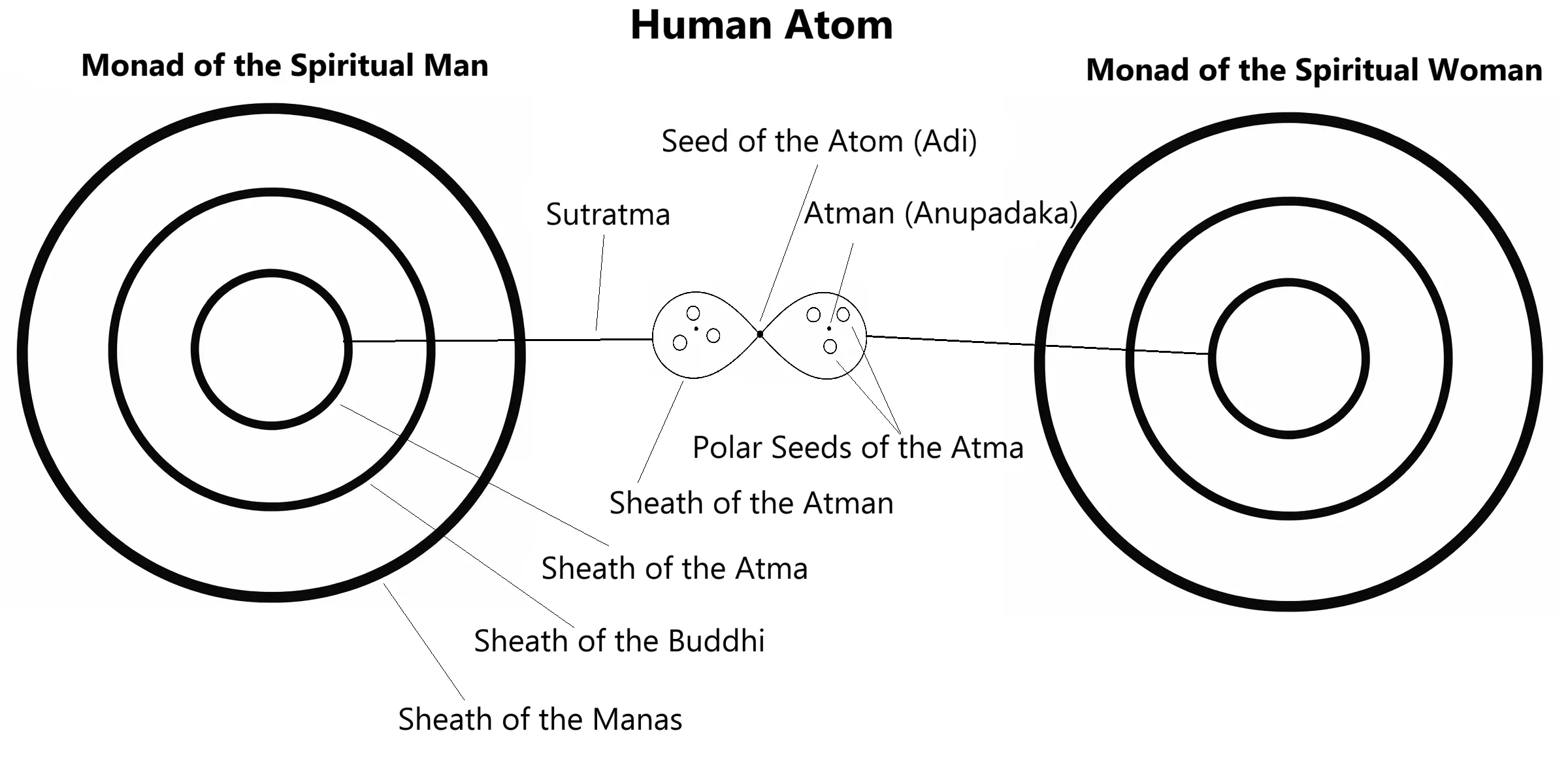
The vibrational frequency of a sheath corresponds to a particular energy level within the discrete energetic spectrum of the human being and of nature (the Heavenly Human). The upper and lower limits of a sheath’s vibrational spectrum correspond to the vibrational range of the respective body of consciousness — or to a plane of matter, when referring to the body of consciousness of the Heavenly Human.
The evolutionary process (which in essence is the same kind of vibration as the vibration of consciousness) corresponds to a kind of breathing, in which a system emits (materializes or brings into being) and absorbs (dematerializes or dissolves) various combinations of SEVs that constitute its body of consciousness. In Kantian field theory, this process corresponds to the operators of creation and annihilation of field quanta. In evolution, this is expressed as the cyclic densification and rarefaction of the sheaths, with the system’s focus of consciousness located in the sheath that is densest at a given moment (the greater the density of matter, the greater its inertia — that is, its capacity to fix vibration and thus to support concentration of consciousness).
In other words, the evolutionary cycle consists of a feminine arc — the descent of the focus of consciousness into matter — and a masculine arc — the ascent out of matter; with each cycle, this circle expands as new vibrations are assimilated. Fig. 2 shows a scheme of the formation of the focus of consciousness of the Heavenly Human within His four sheaths, moving successively downward and upward along the descending and ascending arcs of the evolutionary cycle, which together make up seven periods (“Manvantaras”). This cycle of the universal (systemic) chain is analogous to the planetary cycle of the passage of the life-wave through seven planetary “globes,” described in detail in The Secret Doctrine [3].
Similarly, faster cycles are formed — the cycles of the monad’s incarnations and the cycles of human sleep — bearing in mind that the shorter the cycle, the fewer layers it encompasses. All cycles are governed by the corresponding breathing of the Atman, up to the point at which the monad’s self-consciousness becomes established on layers above the planes of incarnation to such an extent that it can resist the magnetic attraction toward incarnation (the materialization of a layer).
The seven energy levels (Fig. 2) of the sheaths correspond to seven energy chakras (resonators) within each sheath. These link adjacent levels energetically and informationally (via the Antahkarana), creating sub-levels within the forbidden zone between the principal levels.
The specificity of the seven (minor) contemporary manvantaras of the universe lies in the development of four layers, primarily those of the Manasic sheath of the Human being. The First Manvantara begins at the energy level of the Buddhic plane (B); the Second at Kama-Manas (K); the Third at Linga (L); the Fourth (the present one) at the Physical level (F); the Fifth at Prana (P); the Sixth at Manas (M); and the Seventh at Atma (A). These seven levels correspond to the active Principles (chakras, layers, and states of consciousness) of the contemporary Man or Woman.
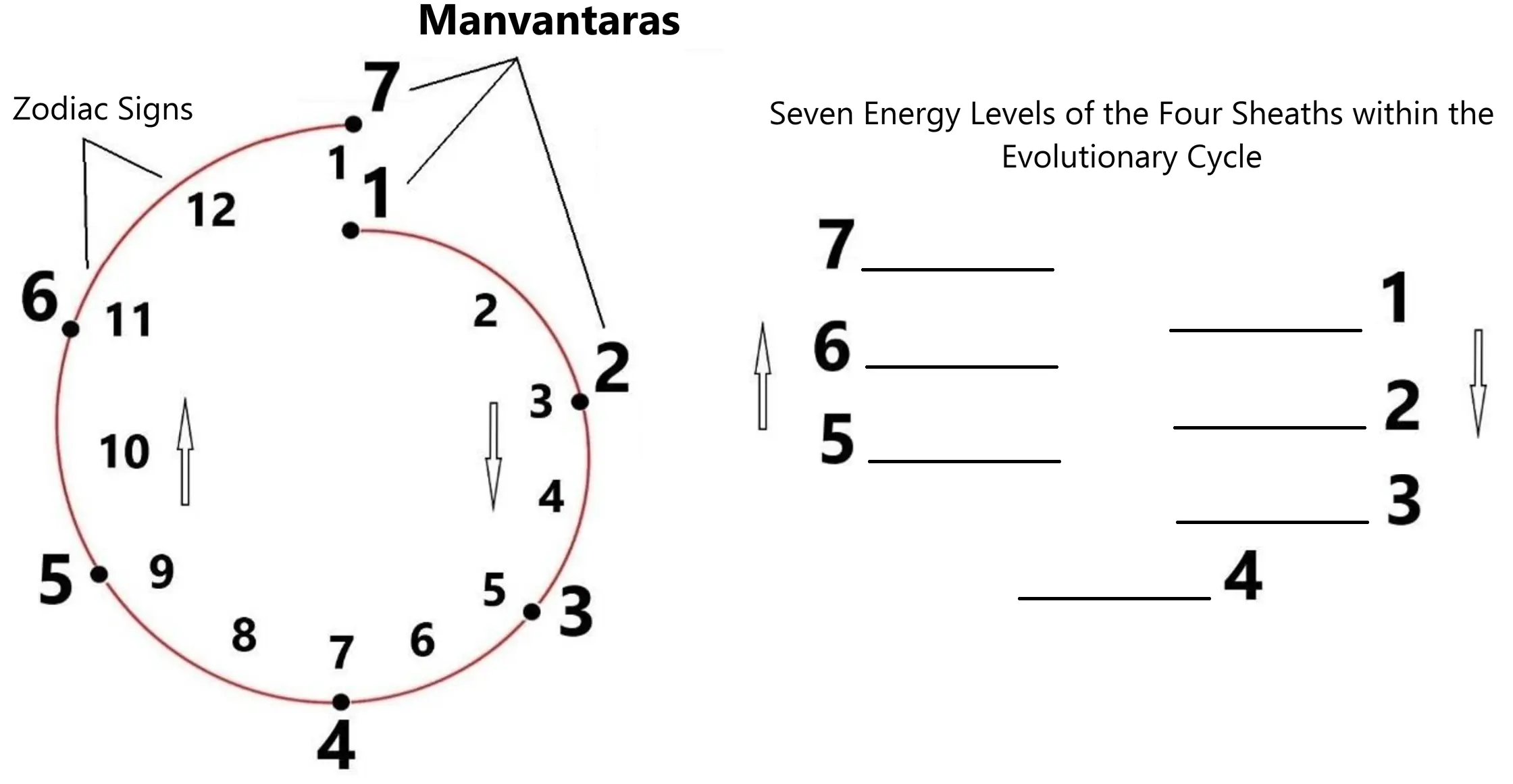
Three downward impulses and three upward impulses within the descending and ascending arcs of the evolutionary cycle correspond to the successive activity of the three Atmic poles of consciousness—independent Entities that focus three kinds of subconscious vibrations of Atman, corresponding to the vibrations in the human Pingala, Ida, and Sushumna channels.
The Atmanic Seed serves as the common point of assembly of the consciousness of the three poles of the Monad within a given sheath. The seed itself, being neutral, remains dormant, that is, non-self-conscious.
The sheath of Atman (and its densification—the sheath of the Atmic body, Atma) forms the human semi-atom, which together with its polar opposite semi-atom constitutes the complete Atom (see Fig. 1) and is located in the core of the Primary Sun, performing the role of a quantum interaction-transmitting particle (a gluon) within the core of the Primary Atom.
The point of assembly of the human Atom is the Seed of the Atom, which, together with its outer sheath, resides on an even higher-frequency and unmanifested plane (Adi) than the plane of the Atmanic Seed (Anupadaka).
Polar-opposite Monads are connected by the finest Sutratma on the highest manifested plane. The presence of this most subtle magnetic bond is equivalent to the existence of a Cosmic Right between Man and Woman with respect to one another.
The three poles of Atma correspond to three bodies (three natures, or sets of Principles) in which a Man or Woman may exist in full self-consciousness:
1) Spiritual body (Fiery): A + B + M;
2) Subtle body: A + B + M + K + P + L;
3)Dense body: A + B + M + K + P + L + F.
Within the ray of the Lord, in the Subtle body, it is possible to separate the Double from Kama-Manas and to exit the Physical body in the set A + B + M + K, leaving the Double within the Physical body.
Thus, through self-consciousness, the Human being links adjacent planes of matter that form the layers of the sheath of the Celestial Human, since its active Principles (the layers of the Manasic sheath required for self-consciousness) are located on neighboring planes of matter—the Physical, the Subtle, and the Fiery.
The composition of the three natures appears to be determined by the necessity of fulfilling two conditions for full self-consciousness:
1) the presence of a connection between the densest sheath and Atman;
2) within the common focus of consciousness on the outer sheath, vibrations of all three poles of consciousness must be represented.
The male and female semi-atoms (atmas) (Fig. 3), in manifestation, each consist of seven energy centers, two of which (Sahasrara and Svadhisthana) are fractional, or strongly polarized—that is, they possess either masculine or feminine petals (stable resonant vibrational modes of the chakra), in accordance with the polarity of the monad. The remaining, less polarized chakras are fractional only in their petals; that is, each petal of the chakra contains both masculine and feminine aspects, and, in accordance with the polarity of the monad, one of these aspects predominates in each petal.
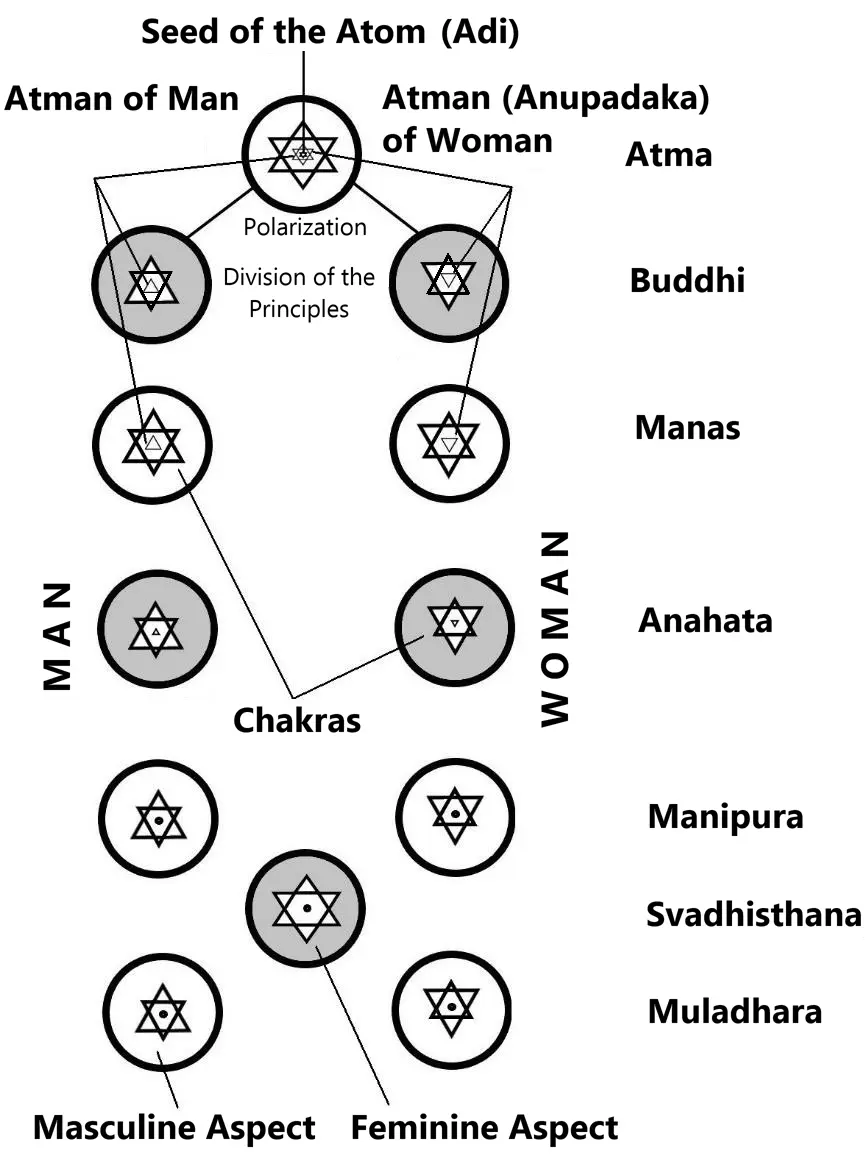
Thus, the Human Atom consists of twelve complete energy centers, or states of consciousness (Fig. 3). Each center corresponds to a Zodiac sign and to a temporal interval (a mark on the clock face) marking the transition of the focus of consciousness along the chain “sheath–body–sheath–body–…” through the twelve “hours” of the evolutionary cycle (Fig. 2) during the period of manifestation of forms. In the “body” phase, consciousness is focused on perfecting the body of consciousness and on the vibrational connection between adjacent sheaths.
The active (masculine) chakras in this scheme alternate with the passive (feminine) ones. The diagram shown in Fig. 3 resembles the ancient symbol of the Fish. If one connects the active head of this Fish (Sahasrara) with the passive sacral center (Svadhisthana), one obtains the Ouroboros—the symbol of the Serpent devouring its own tail (self-generating), with nine chakras (or ten, if Atman is counted as a chakra, which is appropriate on the unmanifest plane). The Ouroboros represents the complete Atom (the Universe) in a contracted state, that is, in pralaya.
References
Photocopies of the notebooks of E. I. Roerich, 1948–1955. State Roerich Museum (originals from the Manuscripts Department of the ICR. ICR Manuscript Department numbering: Nos. 201–239).
V. Grushko, Ergodic Hypothesis of Consciousness, NeuroQuantology, 17 (5) P 35-49 (2019) doi: 10.14704/nq.2019.17.05.2365,
URL: https://neuroquantology.com/open-access/Ergodic+Hypothesis+of+Consciousness_13438/
Blavatsky, H. P. (1888). The Secret Doctrine: The Synthesis of Science, Religion, and Philosophy, Volume I: Cosmogenesis. Theosophical Publishing Co., London.
*dumerion@gmail.com