
What is consciousness
A hypothesis that explains the action principle of consciousness on the base of extremely simple mathematical model of a plane wave is proposed. The doctrine of the reincarnation of consciousness in the physical world is indicated as a consequence of the mathematical property of the cyclicity of a complex number. Based on the consideration of "Vibration" the zonal structure of the world nearest to human perception is shown. An interpretation of the attraction and repulsion forces origins, effects of dark matter, dark energy, levitation, teleportation, the law of karma, as well as Heisenberg uncertainty principle in terms of the interacting vibrations are given. The work will be interesting to everyone who is looking for the answer to the question: "What is the essence of consciousness?"
Introduction
Unfortunately, today there is no clear idea of what consciousness is. (Velmans 2009). In this article we will try to give a clear explanation of the action principle of consciousness on the base of the "Vibration" concept consideration.
What is Vibration?
Generally speaking, Vibration is a universal model with which one can explain any phenomenon within a causal relationship. In this article, the term "Vibration" is understood as a wave process, known in quantum mechanics as a wave function or \(\Psi\) -function (Weinberg 2013) of the form of the so-called plane wave:
where: \(\Psi_ {A}\) is the vibration amplitude, \(\omega_0\) and \(\vec {k_0}\) is time frequency and spatial wave vector, \(\varphi\) is the phase of vibration, \(\vec {r}\), \(t\) is the current place and time of vibration manifestation from the outside observer point of view.The equation \(\eqref{eq1}\) is a complex number defined in mathematics as the sum of two terms. The first term is the real (observable in practice) part of a number, the second term is imaginary part. It is usually not customary to interpret a complex number in the context of an awareness process. However, we will show that our explanation of consciousness directly implies that the \(\Psi\)-function is the function of Psyche, or consciousness, which is characterized by cyclical exchange of information with the outside world (the first term in the equation \(\eqref{eq1}\)) and with the inner world, through imagination (the second term in the \(\eqref {eq1}\) equation).

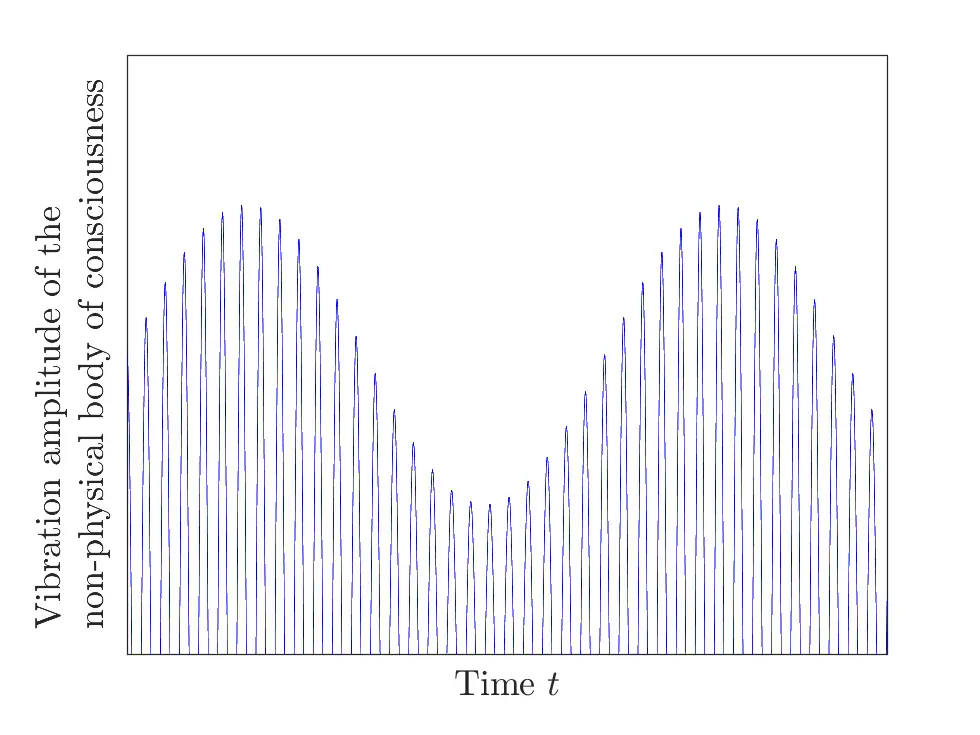
The real part of \(\Psi\) of the form \(\eqref {eq1}\) is shown in . The imaginary part is not available for direct measurement and therefore, strictly speaking, cannot be displayed graphically on the real axis. This inaccessibility is due to the fact that the imaging signals of the \(\Psi\) system are recorded at the carrier frequency that is inaccessible by physical instruments (see ). The carriers of such high-frequency vibrations are bodies that belong to higher energy range in comparison with the physical range (which will be discussed later).
The practical inaccessibility of such vibrations naturally leads to the idea of displaying the values of their amplitudes in another dimension. That is on the axis perpendicular to the real axis \(X\). In mathematics, it is customary to denote this imaginary axis as \(Y\). In this case, the values on the \(Y\) axis are not visible at all (not projected) on the \(X\) axes. If we assume the existence of even higher compared with the world of imaginarity of \(\Psi\) energy ranges, on which this system can exist, then to describe it, we will have to introduce new and new dimensions into consideration.
An important mathematical feature of the \(\Psi\) system of the form \(\eqref{eq1}\) is the periodic change in the numerical relationship between its real and imaginary parts (Solomentsev 2001). At some periods of time, the real part prevails - it is the stage of the embodiment of the system in the physical world. Whereas in other periods the imaginary part prevails - it is the stage of the disembodiment of the system, when the transition of the consciousness of the system into a world corresponding to its imagination is takes plase. For the human system, this period corresponds to the state of the physical body death. Thus, the well-known in esoteric the doctrine of reincarnations (Roerich 1979) can be a consequence of the elementary property of a complex number.
In the basics of mathematical analysis, it is proved that a function \(\Psi\) of any kind (periodic or non-periodic, continuous or discrete) can be represented as combinations of functions \(\eqref {eq1}\) called Fourier integrals or Fourier series (Zygmund 2002). Since any physical system can be considered as a quantum-mechanical system with a wave function \(\Psi\) corresponding to it (Landau and Lifshitz 1977), this simply means that any phenomenon of Nature can be interpreted as a combination of certain vibrations. In other words, this means that any phenomenon from an elementary particle to the Universe is a manifestation of this or that consciousness.
What vibrates, relative to what and with what frequency?
From the previous paragraph on the definition of vibration, it follows that everything vibrates in Nature. We will focus on the fact that whatever vibration is considered, it will be the vibration of the body of consciousness of a particular system. Mathematically, as we have indicated, vibration is the change of a certain complex number (see \(\eqref {eq1}\)). Physically, this number is a measure of information which the system is exchanged with the outside world (\(Re\left\lbrace \Psi\right\rbrace\)) and with its binding internal kernel (\(Im\left\lbrace \Psi\right\rbrace\)) which will be discussed later. One kernel (individuality) can have a range of bodies - carriers of vibration.
The measure of information is the number of elements of the system \(\Psi\) by which it exchanges with the environment. For a quantum particle with a wave function of the form \(\eqref{eq1}\) such elements can be virtual particles rhythmically absorbed (inhaled) and radiated (exhaled) by it.
Each body of consciousness has its specific frequency range, in which it is able to vibrate. We will show further that vibrations of a different frequency range, if they are too large or too small, will not be perceived by such body.
In our consideration, we assume the relativity of everything except the incomprehensible Absolute. Relativity can be interpreted as the parsimony of Nature in the use of various kinds of spaces and dimensions, when everything can be measured with respect to one concept - vibration. For example, moving a body in space, for definiteness along the spatial axis \(X\), can only mean a change in the frequency of its "spatial" vibration \(\omega_ {X}\).
Indeed, draw attention to the formula \(\eqref {eq1}\), which we determined the vibration. The expression \(\vec {k_0} \vec {r} - \omega_0 t\), describing the movement of the \(\Psi\) system in space and time can be represented as:
Here: \(\omega_X = 2 \pi v_x/\lambda\) is the spatial component of the particle frequency moving along the \(X\) axis with a speed of \(v_x\). \(N_X = x/ \lambda\) is the number of oscillations made by the system on its path \(x\), \(\lambda\) is the length of one oscillation. \(N_0 = \omega_ {0} t\) is the number of temporal oscillations made by the system during the time it passes the path \(x\).Thus, the fundamental difference between space and time is reduced to the difference between the spatial and temporal components of the frequency and can only be due to the features of the perception of these frequencies by the consciousness of \(\Psi\) and the consciousness of an outside observer.
The total frequency \(\omega\) of the system vibration \(\Psi\):
expressed by the difference of the spatial and temporal components. According to \(\eqref {eq2}\), \(\omega\) can also be represented by the difference in the number of spatial \(N_X\) and time \(N_0\) oscillations. Note that the passage of time is usually either not noticed, or is experienced by the consciousness as an irretrievable loss. In other words, \(\omega\) represent the energy balance of system between the energy acquired in the process of movement and the energy spended as a result of vital activity. The viability of the system is determined by the requirement of its frequency positivity: \(\omega> 0\).Thus, only the temporary dimension \(t\), measuring the life cycle of the system can be considered as objective dimension. The objective reference point of time \(t\) and the phase \(\varphi\) of any matter is the appearance of the primary (atomic) particle of this matter during the birth of the Universe.
In such interpretation, the spatial remoteness of the planets and galaxies will only mean their vibration remoteness, and the entire Universe can be packed into one point of a certain “real” space. In this is the ergodicity of our hypothesis. The whole Universe is only a “point” in conditional reality, one vibrational state. And each part of this Universe is the same point, which at some moment in time passes the state of the Universe. Moreover, the number of such states is infinite. When the state of awareness of the Universe as a body of consciousness is reached, the individuality corresponding to this state can open its kernel of consciousness as an internal Universe and move to a qualitatively different, wider range of vibrations.
Any changes in the Universe reach to all its parts at the same time, but they manifest themselves at different times, proportional to the inertia of this or that body of consciousness and the vibration remoteness of this body from the source of influence. Matter with the same inertia forms the world with a certain maximum manifestation speed of interaction between bodies. This speed is described by the world constant. For the world of physical matter, this is the constant of the speed of light \(c\), which determines the speed of the reaction of matter to the electromagnetic influence. Practical simultaneity of any impacts in the Universe negates attempts to detect the effect of velocity addition when it comes to the most rapidly reacting matter in this or that world. Therefore, for example, it is impossible to detect the ethereal wind in the experiments on the detection of the ether (Nagel et al. 2015).
Let us estimate the eigenfrequency of physical matter.We will consider the natural frequency as the cyclic frequency \(\omega = 2\pi /t\) of the system, corresponding to the average speed of oscillations that occurs in this system during its life \(t\). For the frequency measurement unit, we will take the reference frequency, which defines the time of the parent system, from the elements of which the system under consideration is assembled.
We define physical matter as matter, which is described using fundamental physical constants: \(G\) (gravitational constant), \(c\) (speed of light in a vacuum), \(\hbar\) (Planck constant). In this case, a hypothetical particle with the minimum possible in physical matter lifetime equal to the so-called Planck time (Planck 1899):
could be a true initial (atomic) particle with a natural frequency: \(\omega = 2\pi /t_ {p} \approx 1.2 \times 10 ^ {44}\) Hz for the physical range of vibrations.Note that today the fastest process registered with using indirect method is the t-quark lifetime \(t_ {q} \approx 5 \times 10 ^{- 25} s\) (Quadt 2006).
It is unlikely that Nature would tolerate a emptiness with a length of twenty orders from the lifetime of the t-quark to the lifetime of the Planck particle. We assume that this range is filled with the lifetimes of a number of so-called ether particles, which constitute the etheric subrange of the physical range of vibrations.
Recall that the ether was rejected by the orthodox science after the unsuccessful attempts to detect the ether wind in the Michelson-Morley experiments (Nagel et al. 2015). But can the absence of wind be considered proof of the absence of air?
Why are parallel worlds practically unregistered by devices?
Because their vibrations are very different from the vibrations of physical matter. Worlds are called parallel because the materialities of these worlds coexist with the materiality of the physical world practically not interacting with it due to the large difference in the frequency of vibrations. Nevertheless, the realities of the parallel worlds are accessible to the consciousness, which has at its disposal bodies from corresponding materialities. How fully these realities are perceived depends on the range of frequencies available to the consciousness, or in other words, from the breadth of the consciousness.
For an ordinary person, three types of materiality are important of which three of person’s most developed bodies of consciousness are collected: Physical, Astral and Mental. Three corresponding to these materialities, the frequency ranges, their energy zones and natural frequencies are presented in .
The discreteness of quantum-mechanical laws is due to the presence of consciousness, or in other words, the individuality of a quantum particle. The individual will of an elementary particle is the reason why it is impossible in principle to predict its behavior with one hundred percent probability. This principle is called the Heisenberg uncertainty principle (Landau and Lifshitz 1977) and it is the basis of quantum mechanics. According to this principle, the field of free variations of the coordinate and momentum of a particle \(\Delta x \Delta p_x\) cannot be less than half of the Planck constant: \(\Delta x \Delta p_x \geqslant \hbar / 2\).
Typical for a quantum-mechanical system the structure of allowed and forbidden energy bands (see ), within which vibrations can either exist harmoniously with each other (allowed band) or suppress each other (band gap) is the discreteness consequence of Nature.
Each allowed band ("plane" or "world") has its own frequency range of oscillations. This range limits the possible frequencies at which the matter corresponding to the band can vibrate. The more inert the atomic particle of matter in the allowed zone, the lower the maximum and minimum frequency boundaries of the band.
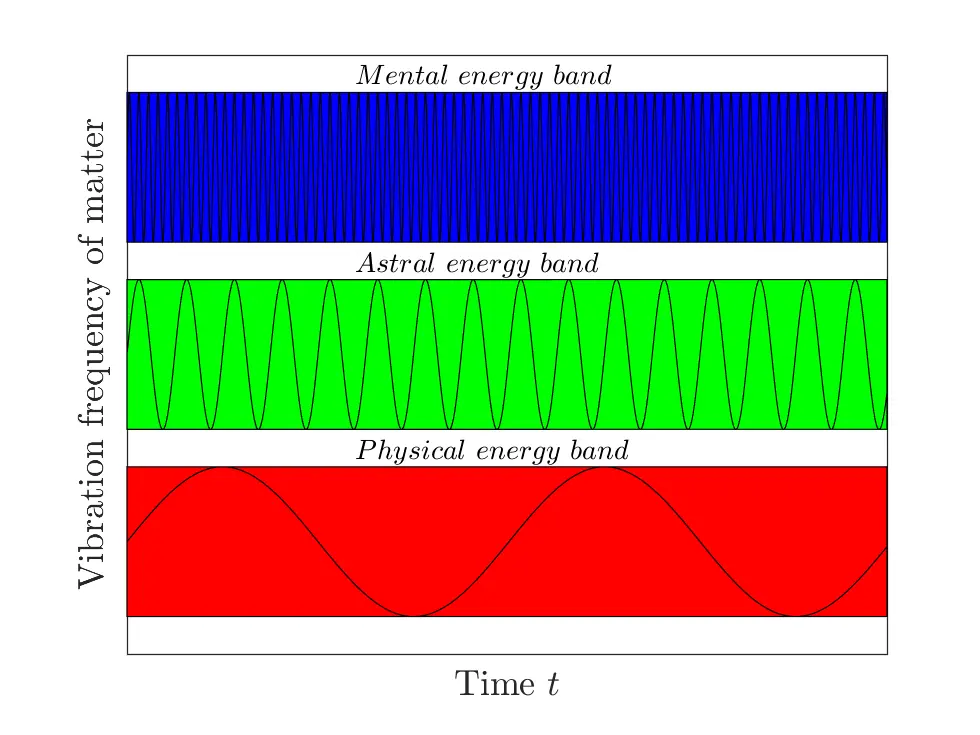
Note that a person when going from the one plane to another feels the band gaps represented on the as a more or less short-term loss of consciousness.
The individuality of any vibration manifests itself primarily in the natural frequency of the body which manifests it. This frequency is in a harmonious (multiple) ratio with the frequency of the spirit kernel that supports the functionality of the body (enliven it).
It is natural to assume that any body from heavy matter ("dense matter") of the low-frequency allowed band is created from a multitude of light bodies of higher-frequency band ("subtle matter"). Therefore, the basis of all vibrations is the same vibration that animates the primary matter of the Universe (from which all other matter originated). That is, in spite of the fact that some body cannot vibrate at some frequency, it can nevertheless experience the influence of this frequency.
In other words external vibration \(\Psi_{ext}\) vibrating with natural frequency \(\omega_{ext}\) in the world of its own (very high-frequency or very low-frequency) materiality , can periodically change the conditions in which the system \(\Psi\) manifests its vibration with the natural frequency \(\omega\). If conditions are favorable, the amplitude of the vibration \(\Psi\) increases, if not - it falls. A number of mechanisms of such an impact are possible, for example, external vibration \(\Psi_{ext}\) can change conditions favorable for spontaneous creation and annihilation of virtual particles necessary for breathing \(\Psi\) which leads to a change in the amplitude of natural oscillations of \(\Psi\):
where \(\Psi_{A_0}\) is the amplitude of natural vibrations of \(\Psi\), and \(\Psi_{ext}(\omega_{ext},t)\) is an additive introduced into the body of consciousness \(\Psi\) by external vibration.It should be noted that the kernel enliven consciousness, which will be discussed later and which vibrates at a much higher frequency than the body of consciousness, can similarly act on the amplitude of oscillations of this body with the frequency \(\omega_{in}\).
The last term in the formula \(\eqref {eq5}\) is the amplitude modulation of the carrier frequency \(\omega_{ext}\). The modulation of one signal by another is a principle universally used in radio, which allows low-frequency information to be transmitted to high-frequency media.This principle is the connecting information bridge between the worlds.
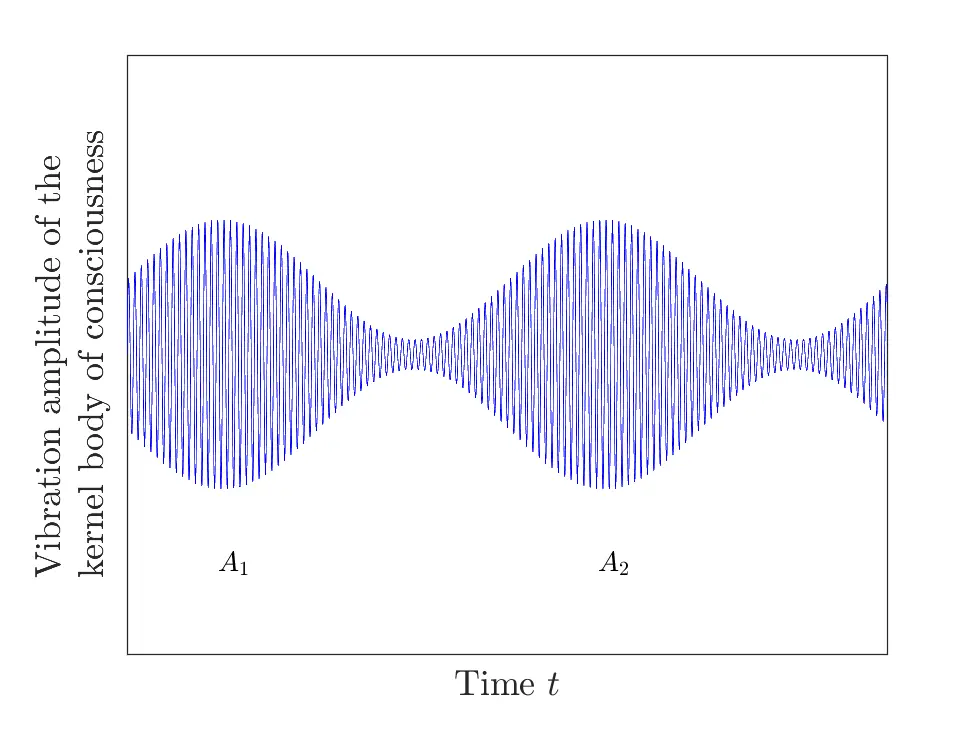
Consider the effect on \(\Psi\) of an external vibration \(\Psi_{ext}\) with frequency \(\omega_{ext}\). If this vibration belongs to the same frequency range (the same world) as the \(\Psi\) vibration, it will simply be added to it according to the superposition principle well-known in physics: \(\Psi + \Psi_{ext}\). This case is described in great detail in quantum mechanics (Landau and Lifshitz 1977) and is not the subject of our consideration.
If the external vibration \(\Psi_{ext}\) comes from the parallel world, then according to \(\eqref{eq5}\) the real part of \(\Psi\) (see ) will look like the one shown on . As can be seen from the figure, the initial vibration \(\Psi\) turns out to consist of a finite number of elemental-carriers of information transmitted from a source external to \(\Psi\) with a carrier frequency \(\omega_{ext}\). Each of the elementals being more or less conscious becomes an element of the consciousness of the \(\Psi\) system.
Let us take as \(\Psi\) a wave function of the form \(\eqref {eq1}\) of a concrete physical system, for example, of a free electron that is guaranteed located in an arbitrary volume \(V\). The difference of the considered function from the standard free electron function adopted in quantum mechanics is the presence of the time and frequency dependence of its amplitude due to the influence of vibrations of parallel worlds, as well as the oscillation phase \(\varphi\), which will be discussed later. For now let us set the phase as equel to zero \(\varphi = 0\) for definiteness.
According to the generally accepted Copenhagen interpretation of quantum mechanics (Bohr 1928; Born 1927; Heisenberg 1930) the probability \(P (t)\) to detect an electron in the volume \(V\) at the moment of time \(t\):
where \(\rho (\vec {r}, t)\) is the probability density, which serves as an experimental measure of the space-time coordinates of the system, described by the wave function \(\Psi\). However, in practice it is impossible to detect an electron instantly. There is always a measuring time \(T\), therefore, in the experiment, the so-called normalization condition for the wave function \(\eqref {eq6}\) is realized not for the instantaneous probability \(P (t)\), but for its average value \(\overline {P}\) with the measuring time \(T\): Substituting in \(\eqref {eq7}\) the explicit form of the wave function \(\eqref {eq1}\), we obtain the normalization condition for its real amplitude \(\Psi_ {A} (t)\) (see \(\eqref {eq5}\)):Since neighboring worlds are separated by forbidden zones, the vibration frequencies of the materialities of these worlds are very different, so \(\omega_{ext}\to 0\) if we consider the influence of worlds that are lower in frequency than physical world and \(\omega_{ext}\to\infty\), if we talk about the influence of the higher worlds.
The frequency remoteness of the interacting vibrations implies a small change in the amplitude of \(\Psi_{A_{ext}}\), so it is natural to expect that in most cases \(\Psi_ {A_{ext}} \ll1\) and the last term in \(\eqref {eq8}\) can be neglected, as the value of the second order of smallness.It is also natural to assume that the interaction intensity is proportional to the frequency of this interaction, therefore \(\Psi_ {A_{ext}} \to0\) when \(\omega_{ext} \to0\), so that the second term tends to zero provided the low-frequency external vibrations. It also tends to zero under the law \(\sim 1 /\omega_{ext}\) at high external frequencies, as the integral of the rapidly oscillating function. Thus, from \(\eqref {eq8}\) we get: \(\Psi_ {A_0} = 1/\sqrt {V}\) and the wave function \(\Psi\) takes the form: \[\begin{equation} \Psi =\frac{1}{\sqrt{V}} e^{i(\vec{k_0}\vec{r}-\omega_0 t)},\tag{9}\label{eq9} \end{equation}\] which completely coincides with the wave function of a free electron normalized to volume, well-known in quantum mechanics. This means that when small external influence (\(\Psi_ {A_{ext}}\ll1\)) is expected in most cases , its impact on the time-averaged probability density \(\rho (\vec {r}, t)\) and on the particle’s wave function normalization \(\eqref {eq6}\) is vanishingly small. In other words, if external vibrations are small, they cannot be observed.
But what if the external vibration is large, for example, there is an action on \(\Psi\) of high amplitude vibration, so that the condition \(\Psi_{A_{ext}}\ll1\) is not satisfied? Obviously, in this case, the last term in \(\eqref {eq8}\) is not small and the probability density \(\rho (\vec {r}, t)\) of detecting an electron at point \(\vec {r}\) at time \(t\) is no longer a constant, as it should be for an ordinary free electron, but will have an oscillating term \(\sim\Psi ^ 2_ {A_{ext}} (\omega_{ext}, t)\cos ^ 2 ( \omega_{ext} t)\). In other words, the electron will experience a external vibration with amplitude of \(\Psi ^ 2_ {A_{ext}}\) and a frequency of \(\omega_{ext}\). But is it possible to register it? In other words, is it possible to measure the energy of this vibration?
According to the well-known formula from quantum mechanics about the measured value of the physical quantity \(F (t)\) (Landau and Lifshitz 1977):
where \(\hat {F}\) is the quantum mechanical operator corresponding to the physical quantity \(F\), and integration is performed over the volume of the space in which the \(\Psi\) system is located.Let us estimate the average energy \(\overline {E}\) of the system \(\Psi\) for the observed period \(T\):
The operator corresponding to the energy is called in quantum mechanics the Hamilton operator \(\hat {H}\) and obeys the Schrödinger equation (Landau and Lifshitz 1977):
From the point of view of consciousness, this equation means that the energy \(\hat {H}\Psi (\vec{r}, t)\) manifested by the body of consciousness is proportional to its temporal evolution \(\frac {\partial \Psi (\vec {r}, t)} {\partial t}\) which is happening in imagination and is not accessible to an outside observer, as evidenced by the imaginary unit \(i\) in the left side of the equation.In addition, this energy depends on the form of the energy operator \(\ hat {H}\), as well as on the boundary and initial conditions of this equation, which correspond to karmic conditions for a person.
Taking into account \(\eqref {eq12}\), the equation \(\eqref {eq10}\) takes the following form for energy:
where the normalization condition \(\eqref {eq6}\) and the explicit form \(\eqref {eq1}\) of the wave function \(\Psi\) with \(\varphi = 0\) are taken into account. Hence, for the energy \(\overline {E}\) average over the observed period \(T\), we obtain: The second term here is: \(\hbar \omega_ {0} = \hbar ^ 2\vec {k_0} ^ 2/2m\) - the measurable (real) kinetic energy of a free electron of mass \(m\), well known in quantum mechanics, and the first term is unmeasurable (imaginary) energy of his consciousness. The imaginary nature of this term is due to the imaginary unit \(i\) at a real value - the integral of the product of the real function \(\Psi_ {A} (t)\) and its time derivative \(\frac {\partial \Psi_ {A} (t)} {\partial t}\).From the formula \(\eqref {eq14}\) it follows that no matter how significant the change in the amplitude of the wave function \(\Psi\), caused by the vibration from the parallel world with the frequency \(\omega_{ext}\), it cannot be measured by an side observer directly. It acts only on the energy of the "imagination" of a particle, and not on the energy of its manifestation in the space-time dimensions of the physical world. And this seems to be quite natural, since no material carrier of vibrations in the range of oscillations of the physical world is able to transfer energy at such frequencies.
Assuming that atomic matter, i.e. the indivisible within plane, is collected from the lowest-frequency states of matter of the higher plane, then any particle of any plane can have at least as many bodies of consciousness in its structure as worlds separate it from the atomic world of Creation. Therefore, the bodies that make up the imaginary part of the vibration \(\Psi\) can be quite susceptible to the vibrations of parallel worlds, if these vibrations are strong enough.
This means that the effect of such an impact will certainly affect the physical plane, but indirectly, through the free will of the particle, whose evolution obeys the Schrödinger equation (see the formula \(\eqref{eq12}\)). The effect will be limited by the possibility of the particle manifestation within the limits dictated by the Heisenberg uncertainty principle and with a high degree of probability will not lead to phenomena significant for the macro-observer (see the e-file \(\eqref{eq18}\)). For a person, such an external vibration effect on his inner world will mean the impression from someone else’s thought, and at the special power of this thought, suggestion.
As will be shown later in cases where an external impact changes not only the amplitude but also the phase of vibration that is under the control of the internal kernel of a particle, the phenomena of the higher worlds can appear in physical matter too.
What is the significance of the phase in the interaction of vibrations?
The process of information exchange (interaction), which is the essence of any vibration (see part 1), is similar to the process of breathing, during which the interacting systems exchange inhaled and exhaled elements. For any force interactions of the physical plane, virtual particles can be considered as such elements.
The field of ether particles, which plays the role of a mediator of interactions on the physical plane, has its own vibration, characterized by a set of frequencies of the physical range and a single initial phase of all oscillations. The unity of the initial phase is due to the instantaneous (by the standards of the physical world) birth of initial atoms of physical matter from the most inert atoms of astral matter during the birth of the Universe. The further formation of all particles of physical matter, including virtual ones, is connected with the phase of the fastest etheric matter from which more inert physical particles are formed. Thus, Cosmos can be likened to a highly synchronized clockwork mechanism, where the birth or destruction of something can occur only during the time intervals assigned to it, measured by the clock of the parent system.
Note that the fastest matter of each plane that is a field of interaction on this plane, is matter with the least free will of its elementary particles. Probably, the obedience and high synchronization of these particles are the cause of the maximum speed of response to the interaction on the plane. However, with the passage of time, the initial atom atoms of the plane manifest free will more and begin to build their own bodies of consciousness on this plane, turning into heavier particles, or go to the higher plane. Such expressions of will are not always harmonious and are the cause of unpredictable fluctuations of the field, which in turn manifests itself as entropy or chaos on the plane.This requires constant synchronization of the field from the side of more developed consciousnesses, which order the field vibration by their own vibration. Otherwise, the field becomes closed and, according to the second law of thermodynamics, an increasingly chaotic system, which hampers the development of other systems on the plane.Thus, the cause of entropy in any system is the unsynchronized will of its parts.
The field of ether particles involved in electro-magnetic interactions can be considered as one of the components of the unrecognized ether, which corresponds to the so-called electromagnetic field vacuum (Berestetskii et al. 1982) in electrodynamics. In the theory of quantum electrodynamics, this non-recognition is costly - the member corresponding to zero oscillations of an electromagnetic vacuum is simply eliminated from the energy formula of the electromagnetic field "due to the fact that the present theory is not logically complete and consistence"(Berestetskii et al. 1982). We insist that the ether (the wind of which cannot be detected, see part 3) mediates all kinds of interactions on the physical plane, with the exception of the weak and gravitational, which will be discussed later.
The exhalation phase of a physical particle corresponds to an increase in the density of the ether field. Ergodicity, i.e. the absence of spatial remoteness implies an almost instantaneous increase in this density throughout the Universe. However, the response to this increase depends on the vibration distance and inertia of the perceiving particles.
The inhalation phase rarefy the ether field.
Graphically, the breathing process (vibration) can be illustrated by the radius of a circle \(R\) which magnitude corresponds to the change in density of the field of ether particles caused by breathing, as shown in . Increasing the radius during exhalation means the manifestation of ether particles.The inhale corresponds to their absorption by the particle’s internal kernel, so that the radius \(R\) decreases as well.
The value of \(R\) on the graphs is numerically equal to the value of the real part of \(\Psi\) (see the formula \(\eqref {eq1}\)):
where, as before, \(\omega\) is the natural frequency of vibration, and \(\varphi\) is its phase.For simplicity, we will assume that the interaction of a particle with ether occurs predominantly at the respiration frequency \(\omega\) of a particle. That is, at the frequency of its main resonance with a set of oscillations (breathing) of the ether field.
Like other quantum processes, we should expect the presence of allowed and forbidden zones in the energy of such an interaction, similarly to . Up to the boundary threshold of the ether field compaction (increase of its energy) the birth of virtual particles from the compacted ether does not occur. Graphically, this correspond to the no-intersection of the breathing radius of the \(R_p\) particle with the breathing radius of the \(R_e\) ether field (in the graphs for the simplicity \(R_p = R_e\)). This means that in such a state there is practically no physical interaction of the particle with the field and, accordingly, with other particles through this field.
The most harmonious combination of breaths, when the exhalation of a particle corresponds to the inhalation of a vacuum and vice versa is characterized by a phase shift of their vibrations \(\Delta \varphi = \pi\). In this case, the vibration radii of the particles \(R_p\) and the ether field \(R_e\) never intersect (see ). Particles having a phase shift relative to the ether field \(\Delta \varphi = \pi\) are electrically neutral.
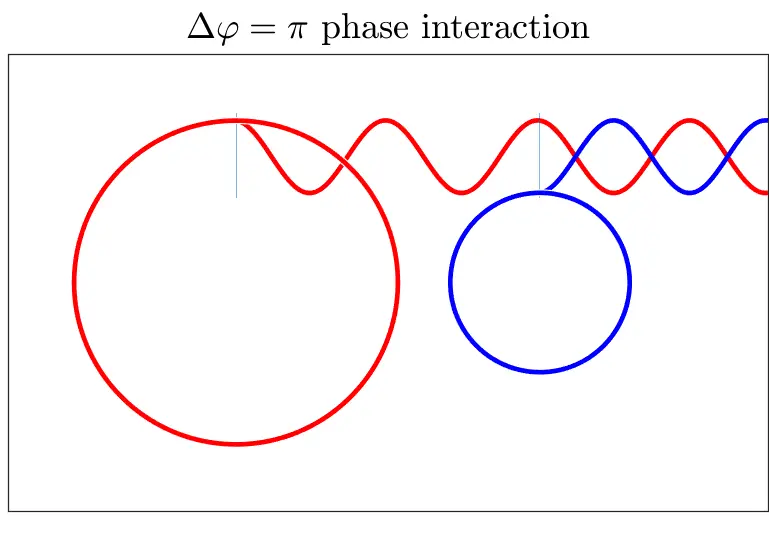
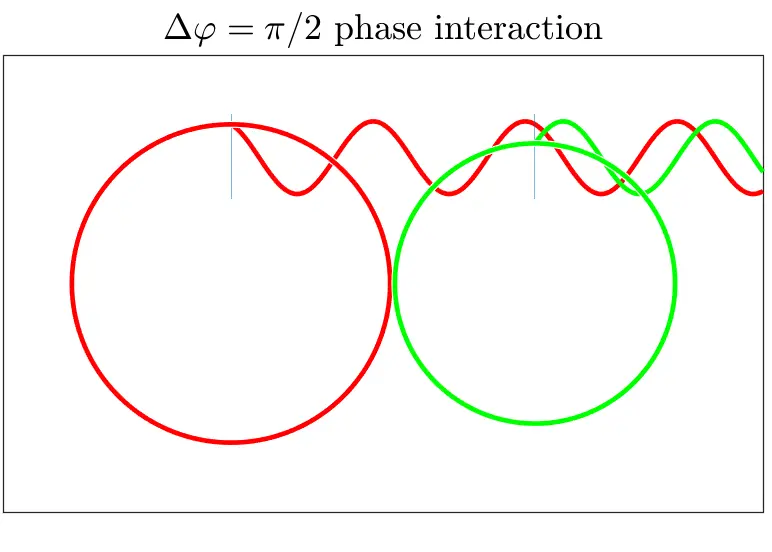
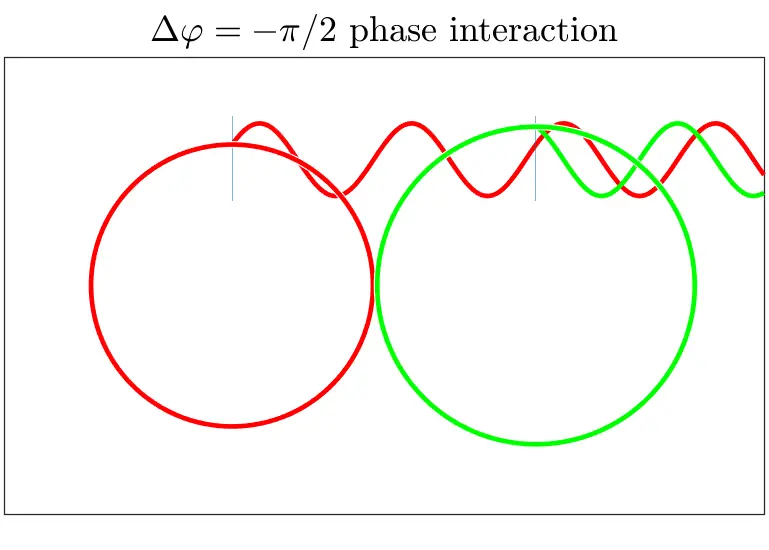
As can be seen from and , the phase shift \(\Delta \varphi = \pm \pi / 2\) corresponds to the active interaction of the particle with the ether field on one of the half-periods of oscillation (either during the inspiratory phase or during the phase exhalation). In such half-periods, the threshold of density of the ether is reached (the vibration radii of \(R_a\) and \(R_e\) of the particle and the ether field intersect), resulting in virtual particles of the corresponding interaction frequency, which occupy the allowed levels in the interaction zone.
The interaction zone determines the type of virtual particles that are being born and the intensity of interaction. I.e. in the presence of a phase shift \(\Delta \varphi = \pm \pi/2\) relative to the ether field, depending on the proximity of spatial vibrations, an interaction of varying intensity arises - electromagnetic in the initial zone and strong in the second. In addition, one can expect the existence of even higher zones, characterized by even more powerful types of interaction (at the level of Planck particles) as compared with strong interaction.
The phase shift \(\Delta \varphi = \pi /2\) of the physical component of the vibration \(\Psi\) (real part of \(\Psi\) in the formula \(\eqref {eq1}\) expressed by cosine) relative to the vibration of its astral body of imagination (imaginary the \(\Psi\) part in \(\eqref {eq1}\) expressed by sine) means that there is an interaction not only between the physical and astral components of \(\Psi\), but also between physical particles through the astral field.
This is the gravitational interaction which much weaker than the electromagnetic interaction. It is so weak that, in accordance with the reasoning of part 4, it is practically not recorded in quantum-mechanical measurements. However, it is very significant on a Universe scale, since the subtle matter that is not observed in the electromagnetic range of vibrations affects physical bodies by means of gravity. In modern astrophysics this matter has been assigned the term "dark matter" cite Sab, although it belongs to a much higher frequency (radiant) type of materiality than physical matter.
The oscillation amplitude of the \(\Psi\) system depends on how many virtual particles generated by the system will find their place at the levels of interaction with the ether.
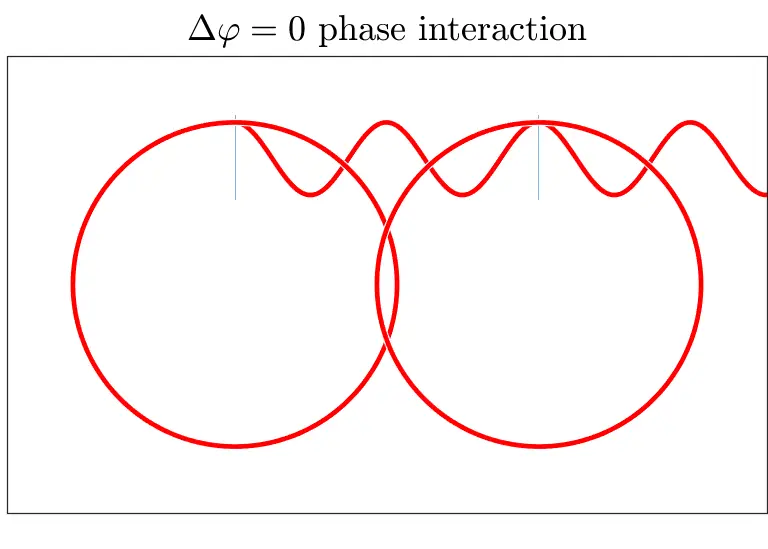
If a part of the exhalation phase of a particle during its interaction with the ether field coincides with a part of the exhalation phase of this field, saturated with another particle with the same phase (\(\Delta \varphi = 0\), see ), then part of the levels in the interaction zone will be busy. As a result, the number of levels of interaction with the field will be insufficient to maintain the full amplitude of oscillations of both particles and this amplitude will be suppressed. Also, the amplitudes of particles saturated by the field during inhale will be suppressed in case of coincidence of breaths of particles of the same frequency, since at the levels of interaction with the ether field there will be an insufficient number of virtual particles to maintain the full amplitude of oscillations. Therefore, in both case, the particles will tend to increase the difference in their spatial frequencies in order to reduce the interaction, i.e. there will be a repulsion between them.
On the contrary, if the phase of exhalation of a particle during interaction with the field coincides the inhalation phase of the ether field depleted by another particle (\(\Delta\varphi = \pi/2\), see ), or the inhale phase of the particle will coincide with the enriched by another particle exhale of field (\(\Delta \varphi = - \pi/2\), see ), then there will be an attraction between them due to the energy benefit from the convergence of their spatial frequencies. Obviously, as a result of this interaction, the amplitudes of the particles will increase, because during the interaction of the particle with the field, one particle will provide additional virtual particles for the other during exhalation, while the other for the first will provide additional levels during inhalation.
Particles that saturate the electromagnetic vacuum during the expiratory phase are positively charged particles. This is the case when the oscillations of the ether field are shifted relative to the oscillations of the particle by \(\Delta \varphi = + \pi/2\) (see ). Particles saturated by the ether field in the inhale phase are negative particles. The phase shift of the ether field relative to their own phase is \(\Delta \varphi = - \pi/2\) (see ). Thus, the phase shift between bipolar particles is \(\Delta \varphi = \pi\), which leads to the possibility of the formation of a neutral atom during the vibration approach of the particles.
The approach to a charged particle \(\Psi\) along the axis \(X\) of another charged particle (that is, the coincidence of the values of their frequencies) violates the equilibrium of \(\Psi\). As a result, \(\Psi\) changes its spatial frequency \(\omega_ {X}\) (see the formula \(\eqref {eq2}\)), wishing either to increase the resonant (attraction) or quench the dissonant (repulsion) vibrations according to :
where \(F_x\) is the force that manifest by the system \(\Psi\), and \(m\) is the measure of inertia with which \(\Psi\) is able to change its frequency. \(m\) here is the mass from Newton’s second law (Feynman et al. 2005).The magnitude of the inertia (mass) for particles of different signs is different due to the different phase shift of their vibrations relative to the vibration of the ether field. Positively charged particles interact with the ether field only during the exhalation phase, while negative ones interact only during the inhalation phase.Positive particles saturate the electromagnetic vacuum with new virtual particles (they fill the levels of interaction with the ether field). But where do the energies of these particles come from, given that during the inhalation phase, the positive particles do not interact with the ether field? Given the law of energy conservation, they can most likely take this energy from the nearest energy zone - from the astral plane. In other words, positive particles inhale matter from the astral plane and exhale on the physical. On the contrary, by virtue of the same law of conservation of matter (energy), negative particles inhale on the physical plane and exhale on the astral. Therefore, positive particles (protons) always have an excess of etheric matter exhaled by them which has not been accepted by the ether field and hence the excess mass. Negative particles (electrons) on the contrary have some drawback (for full amplitude) inhaled ether particles and have a lightweight ether body.
In addition, negative particles do not have such an excess of exhaled matter as positive ones, because by virtue of a higher frequency (subtle) structure the levels of interaction with the astral field are much more numerous than the ethereal, and almost all matter exhaled by negative particles is taken by the astral field.
The practical not saturability of the astral levels with physical particles leads to the fact that the gravitational interaction due to the interactions of the vibrations of physical and astral bodies shifted by \(\Delta \varphi = \pm \pi / 2\), has the character of attraction, despite the possible coincidence of the phases of physical bodies relative to the astral field.
Note that in the case of the interaction of an electrically neutral physical body with an astral field (with a phase difference between them \(\Delta \varphi = - \pi / 2\)) and an astral body (with a phase difference between them \(\Delta \varphi = \pi / 2\)), the phase shift between the astral body and the astral field will be: \(\Delta \varphi = \pi\). I.e. in this case there will be a gravitational interaction of the electrically neutral on the physical plane of the physical body with the electrically neutral on the astral plane astral body.
With a large proximity of the spatial frequencies of interacting systems (small distances between them), the gravitational interaction passes into a higher-energy zone of the so-called weak interaction.
However, with large differences in the spatial frequencies of interacting systems (at large distances on the scale of the Universe), the levels of interaction of physical matter with the astral field are more densely populated with astral virtual particles than at small differences (on the scale of the galaxy). The reason for this is that the larger the difference in frequencies, the less the system (in this case, the astral field) feels the change in this difference. As a result, with large differences in the frequencies of interacting systems (which correspond to the edge of the zone of interaction of physical matter with the astral field), a part of the interaction zone almost always appears to be filled and therefore the anti-gravity effect of repulsion of electrically neutral physical systems must manifest. This happens due to the fact that, as we have said, they have the same phase shift relative to the astral field. This may be the explanation of the mysterious dark energy, which in modern astrophysics is attributed to the observed accelerating scattering of galaxies cite Kra.
The vibration phase \(\varphi\) of the body of consciousness \(\Psi\) (see the \(\eqref {eq1}\) formula) can be represented as:
where the \(\varphi_0\) is its own phase of oscillation of the body of consciousness of the system, inherent in it from birth and determining the charge of the particle.\(\varphi_ {in} (\vec {r}, t)\) is the phase shift caused by own kernel’s will of the particle, which is the cause of the uncertainty in the measurement of its energy \(\Delta E\) during the registration time \(T\):
according to the Heisenberg principle (Landau and Lifshitz 1977). The phase \(\varphi_0\) of the nascent particles is acquired by them with respect to the phase of the electromagnetic component of the ether field \(\varphi_e\). The "condensations" of this field are the ethereal particles from which the bodies of consciousness of real particles are composed. For definiteness, we set \(\varphi_e = 0\).For the developed consciousnesses of the opposite poles, the interaction of vibrations with \(\Delta \varphi = \pi\) corresponds to love drives. Physical particles which vibrations are shifted relative to each other by \(\Delta \varphi = \pi\) or \(\Delta \varphi = 0\) interact by electromagnetic forces of attraction or repulsion, respectively.
The overall phase of the body of consciousness is determined by the cumulative vibration of all its parts. For example, suppose for simplicity that the physical body consists only of three kinds of particles: protons and neutrons, forming the nuclei of the atoms of the physical body and the electrons forming the shells of these atoms. Suppose also for simplicity of consideration that all electrons are localized at their atomic nuclei. In this case, the frequencies of the vibrations of the protons \(\omega_p\) and the corresponding electrons \(\omega_e\), as well as the amplitudes of these vibrations \({\Psi_A} _p\) and \({\Psi_A} _e\) which determine the probabilities of detecting particles in these localizations will be close to each other: \(\omega_p \approx \omega_e\), \({\Psi_A}_p\approx{\Psi_A}_e\), so taking into account \(\eqref {eq1}\), the total vibration of a proton-electron pair of an atom:
because, as is known, \(cos (\pi / 2) = 0\). Therefore, the total vibration of protons and electrons of an electrically neutral physical body is close to zero and the total vibration of the body \(\Psi\) is determined by the total vibration of neutrons. So the phase shift of the vibration of the physical body relative to the vibration of the ether field in this case corresponds to \(\Delta \varphi = \pi\) (see ).What conditions allow higher-world phenomena in physical matter?
For this it is necessary that the external to the physical plane high-frequency vibration affects not only the oscillation amplitude of the observed body of consciousness but also the phase \(\varphi\) of these oscillations. The change in the phase of a physical particle, which it acquires at birth and which is under the control of its internal kernel, is associated with the energy of creation of this kernel. Apparently only the deliberate exposure to high levels of consciousness can lead to electro-magnetic phenomena in the physical matter of any kind.
In the case of impact on a human kernal its corresponds enhancement or suppression will. The mechanics of such a vibration effect on the system \(\Psi\) is reduced to providing this system with alternative resonances of special power, which at the time of the impact are perceived by this system as more energetically beneficial and as a result \(\Psi\) re-arranges its vibration.
A sufficiently developed spiritual kernel, similar to a human one, is able to collect (attract) a significant part similar (cognate) elementary particles from different materialities into own bodies of consciousness, therefore such bodies will be well coordinated. In this case, a change in the vibration phase of one body will affect the vibration phase of the other body. Those In well-coordinated systems, the impact on the phase of a body of consciousness can be carried ext not only by the kernel, but also by the more energetic body of consciousness.
In general, the phase \(\varphi\) of the \(\Psi\) system can be written as:
where \(\varphi_{ext}(\vec{r}, t)\) is the delay or ahead of the body of consciousness oscillations caused by an external, either very strong, or well coordinated vibration.Vibrations of, for example, the etheric or astral bodies of an incarnated or recently disembodied person are well coordinated with the vibrations of physical matter. Such vibrations are capable of affecting not only the physical body of the person himself, but due to the large affinity with the physical plane, to produce phenomena in physical matter in general.Taking into account \(\eqref{eq20}\), the expression \(\eqref{eq14}\) for the energy of a free particle measured for time \(T\) takes the form:
here, for simplicity, it is assumed that the functions \(\varphi_{in}\) and \(\varphi_{ext}\) of the considered free particle do not change with its coordinate \(\vec{r}\), i.e. are only functions of time \(t\). Also, to simplify consideration, we assume that the dependence of the phases \(\varphi_{in}\) and \(\varphi_{ext}\) on time \(t\) is linear. Then the values \(\varphi_{in}(T)-\varphi_{in}(0)\) and \(\varphi_{ext}(T)-\varphi_{ext}(0)\) are simply proportional to the number of oscillations \(N_{in}=\Delta\omega_{in}T/2\pi\) and \(N_{ext} =\Delta\omega_{ext}T/2\pi\) by which the vibration of the \(\Psi\) system can be accelerated or slowed down during the measurement (exposure time) \(T\). \(\Delta\omega_{in}\) and \(\Delta\omega_{ext}\) are changes in the frequency \(\omega\) of the system due to changes in its internal and external phases, respectively.The third term in the formula \(\eqref {eq21}\) \(\hbar\Delta\omega_{in}\) corresponds to the value \(\Delta E\) (see \(\eqref {eq18}\)) uncertainty of the particle energy measurement. This uncertainty is associated with the manifestation of the vibration of its internal kernel and expresses the free will of the particle
while the last term \(\hbar\Delta\omega_{ext}\) on condition that: \(\left|\Delta\omega_{ext}\right|\gg1\) can lead to significant phenomena caused by external vibration.For example, in accordance with , when \(\Delta\omega_{in} = 0\), the particle’s energy \(Re\left\lbrace\overline{E}\right\rbrace\) will be determined by the expression: i.e. with a positive value of \(\Delta\omega_{ext}\), it will decrease. This behavior is typical for the dematerialization of the system (reduction of physical activity), when part of its vibration moves to a higher compared to the physical plane frequency range. In a given case, such a transition will be energetically beneficial, since the condition \(\left|\Delta\omega_{ext}\right|\gg1\) that is equivalent to \(\left|\varphi_{ext}(T) - \varphi_{ext}(0)\right|\gg1\) (with non-vanishingly small \(T\)) means multiple repolarization of \(\Psi\) which makes its development (energy growth) on the physical plane difficult.The case: \(\left | \varphi_{ext}(T) - \varphi_{ext}(0) \right | \ll 1\) corresponds to the gravitational influence exerted on the physical body of the system by the subtle bodies of other systems.
The case: \(\left | \varphi_{in}(T) - \varphi_{in}(0)\right | \approx - \pi/2\div\pi/2\) corresponds to the strength of the connection between the subtle and physical bodies of the \(\Psi\) system.
An effective coordinated connection between human bodies enables the central spiritual kernel to manage its more coarse-material shells, when one shell controls another. Such control is carried out by changing the phases of certain vibrations. Depending on the phases of the vibrations of a high-frequency (subtle) body, there is a vibration and corresponding to it the chemical activity of certain chemical elements and compounds of the low-frequency physical body. In other words, when the vibrational field (spatial chemistry) changes in various thin bodies, this causes a change in the electro-chemical reactions of the corresponding elements of the coarse bodies. Electrochemical reactions, in turn, control the generation of nerve micropulses, muscle reflexes, hormone release, etc.(Shepherd 1983), (Stryer 1995).
The phase shift \(\Delta\varphi = \pi/2\) between the bodies (see \(\eqref {eq1}\)) corresponds to the attraction in which the physical body nourishes the subtle (the exhale of physical coincides with the inhale of subtle). When \(\Delta\varphi = -\pi/2\), on the contrary, the subtle nourishes the physical (the exhale of the subtle body coincides with the inhale of the physical). When \(\Delta\varphi=0\) repulsion occurs between the bodies, as a result of which the subtle body can free itself from the physical.
If we consider a human as a dual vibration system \(\Psi\) of the form , then the kernel of such a system will be its imaginary part corresponding to the subtle body of human. When the phase of the subtle body changes with time, for example, according to the law:
due to the phase coherence, it is able to change the spatial frequencies \(\omega_ {X}\), \(\omega_{Y}\), \(\omega_{Z}\) of the physical body (see the formula \eqref{eq2}) by \(\Delta\omega_{X}\), \(\Delta\omega_{Y}\), \(\Delta\omega_{Z}\) respectively. This means the ability of the physical body to levitation and moving in space.In fact, in this case, in the absence of an external influence (\(\varphi_{ext} = 0\)) and taking into account \eqref{eq1}, \eqref{eq20} and \eqref{eq24}, the system \(\Psi\) undergoes a spatial transformation \(\Psi\xrightarrow[]{\varphi_{in} = \varphi_{s}}\Psi_s\), namely:
where \(\Psi_s\) is the wave function of the system \(\Psi\) that is shifted in space.It should be noted that the breathing of system (vibration) is a discrete process, due to the capture and release of virtual particles by the kernel of the system. A similar discrete process is the change in the frequency of vibration, due to the capture and release by the chakras (subsystems \(\psi\) similar to \(\Psi\)) of information elementals. In other words, there are minimally possible spatial increments (quanta of space): \({\Delta\omega_{X}}_{min}\), \({\Delta\omega_{Y}}_{min}\), \({\Delta\omega_{Z}}_{min}\) such that:
where \(a\), \(b\) and \(c\) are integers (\(a, b, c\in\mathbb{Z}\)).The physical space quanta are virtual particles that are composed of the primary virtual particles of the plane - the time quanta of the plane. The primary respiration of the system is due to the inhalation and exhalation of time quanta by the kernel of the system. Secondary respiration is caused by inhalation and exhalation of space quanta. The number of the space quanta types corresponds to the number of spatial dimensions and the number of chakras that the system breathes. Each chakra has its own base frequency, corresponding to the frequency of the space quanta’s tipe. The spatial vibrations of the chakras are connected together by the basic vibration of the kernel, in other words, are multiples of this vibration. Changing the frequency of chakra vibration means moving the system along the corresponding to chakra a spatial dimension. Each chakra of system perceives only that spatial vibration which corresponds to the basic spatial frequency of the chakra. Probably the first thing that every vibration manifested on the plane learns is the ability to distinguish spatial frequencies, i.e. ability to move around the plane or walk. It is also likely that the movement of the system from plane to plane is due to the secondary respiration of the kernel itself which changes the base frequency of the system. The quanta inhaled and exhaled by the kernel during such displacement of the system correspond to both time and space. They are composed of materiality that is primary for all the planes on which the system is capable of moving.
If the power of the thin body is such that the physical body can first be dematerialized on a subtle plane, and then after changing the spatial frequency can be materialized on the physical one, then we will deal with teleportation.
What is Consciousness?
Consciousness is a cyclical self-consistent change of information in feedback with the kernel holding it. This kernel is the Heart of Consciousness.
Any cyclic change of something can be represented by rotation in one or another space. The energy of this rotation is the psychic energy of consciousness. The essence of rotation is the cyclical change of some quality of consciousness. This is an oscillatory process, or vibration (see p.2), which can be mathematically represented by rotating the complex number around the origin (center of the system) in the complex plane \(Z\) during time \(t\).
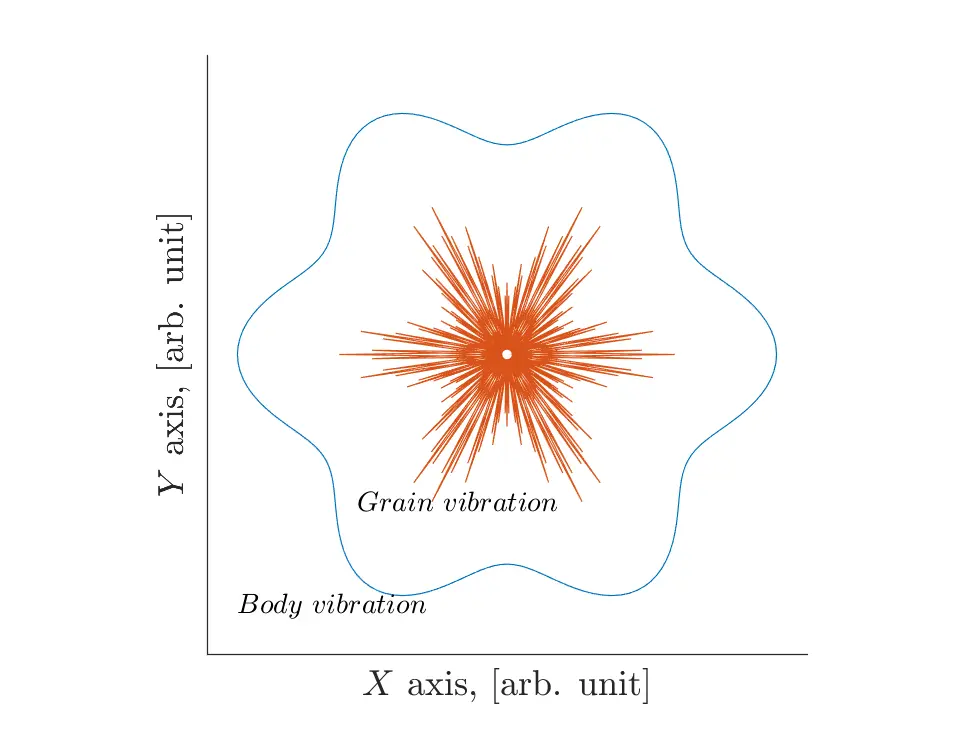
Any cyclic process not only models consciousness, but is consciousness to the extent that it manifests feedback between a rotating element (body) and its center of rotation (kernel). Physically this feedback is based on the natural ability of any oscillating system to respond predominantly to those external signals which frequency is a multiple to the own frequency of the system oscillation. This phenomenon is called resonance in physics.
Any physical body is the real part (\(Re\lbrace\Psi\rbrace\)) of some vibration \(\Psi\) (see p.2). The imaginary part of this vibration (\(Im\lbrace\Psi\rbrace\)) is a subtle body of system \(\Psi\). At the simplest consideration of the \(\Psi\) system, its subtle body can be considered as the kernel of consciousness, and physical body as body of consciousness.
The high-frequency internal vibrations of the kernel are amplitude-modulated according to the low-frequency vibrations of the body. This provides informational communication between them.
The inner vibrations of the kernel increase the vibrations of the body of consciousness, which also perceives vibrations (information) from the outside of system (see ). Oscillations of the body of consciousness, in turn, increase the vibrations of the kernel. The feedback circle is closed. There is a self-awareness system.
Structurally, the kernel of consciousness is similar to consciousness itself, i.e. It also consists of a rougher low-frequency body (\(Re\lbrace\Psi^{'}\rbrace\)) and a high-frequency core (\(Im\lbrace\Psi^{'}\rbrace\)) that animates it. Such enclosures should be extended to infinity. Thus, whatever consciousness bodies were destroyed as a result of these or those processes, consciousness itself will be potentially indestructible and able to manifest itself on one or another plane as soon as the core collects the body corresponding to the plane.
Symbolically, consciousness can be represented by a circle of information ("c O n" (together) "scio" (to know), Latin) with a point in the center that holding this information. The circle itself symbolizes the body of consciousness, and the point in the center is the core of consciousness, which is the heart and soul of the system. It keeps the body of consciousness from decay and animates (inspires it). The kernel of consciousness is like a grain, which gradually grows from the inside to the outside and manifests itself in the body of consciousness, in proportion to the efforts of this consciousness. The information accumulated during the life cycle of the body of consciousness is stored in the kernel. In each new incarnation, the kernel transfers information to a new body. When a sufficiently high level of development is attained, the core is able to modulate its high-frequency vibrations with low-frequency vibrations of the body so successfully that the soul’s information about past incarnations becomes available to the body. In other words, the memory of past incarnations falls into the physical brain. The experience gained by many incarnations is gradually and more and more often revealed in moral values, character traits, talents and charisma.
Psychic energy accumulated in the form of experience is capable of affecting everything, since everything is vibration, and psychic energy is the energy of this vibration. The measure of this impact depends on the degree of consonance (arising resonance) between vibrating systems.
Since certain events (as well as everything that one can imagine) are vibrations, first, there is a connection between events and consciousnesses, which is the basis of the law of Karma. Secondly, any event is to some extent conscious, since consciousness is only a measure of the self-consistency of vibration. It is obvious that any vibration as a cyclic (repetitive) process is always to some extent self-consistent.
A worldview based on the understanding that everything are consciously make a human more responsible, firstly, for how a person relates to the world in which he lives and, secondly, for his inner world, i.e. for the quality of constantly generated by him small minds of his thoughts and feelings.
Conclusions
Vibration (wave function \(\Psi\)) is a cyclical change of some information recorded on a this or that material carrier (body). Cyclicity implies the stability of this information relative to the equilibrium point or center of rotation directly related to the internal body or kernel that maintains vibration. The inner kernel is always hidden or imaginary (\(Im\left\lbrace \Psi\right\rbrace\)) from the point of view of an outside observer in contrast to the external body, which is always available to the observation or real (\(Re\left\lbrace \Psi\right\rbrace\)). Irreversible removal of the inner kernel from the body (disincarnation) leads to the disintegration of the body.
Therefore, the essence of life consists in the unity of the body of consciousness and the kernel that animates it.
Self-consciousness is a vibration in which the feedback between the inner kernel and the outer body reaches the level of sensation of one’s own individuality. Strictly speaking, any vibration is a consciousness of this or that level, and any phenomenon of Nature is a vibration since any phenomenon can be described by a wave function.
In reality, the dual picture of consciousness is only a very simplified model.Closer to the truth, one can say that any consciousness is threefold. It has an external body, where the consciousness is most easily concentrated, because the vibrations of this body are the least rapid, the internal body (soul), which the mind uses when working its imagination and, finally, the internal kernel (spirit), which revives the external bodies. Moreover, the number of bodies of consciousness must be infinite, since any body of any plane is a vibration that has a hidden part on the higher plane. But what can limit the number of planes of Infinity? Nevertheless, to clarify the principle of action of consciousness as a feedback between external and internal information carriers, the dual model is quite suitable and is mathematically based on the algebra of a complex number.
The possibility of representing a vibration by a complex number rotating in time on a complex plane \(Z\) around its point of origin indicates the natural property of every vibration (consciousness) to move from the imaginary phase to the real phase and vice versa. In other words, any phenomenon of Nature (including human) is a constant change of materialization and dematerialization, or embodiment and disincarnation of consciousness.
The ergodicity of consciousness consists in its fundamental ability to instantly interact with any other consciousness of Nature and achieve the same states of development as any other system.
The spatial remoteness of various systems of the Universe can only mean their vibration remoteness, which makes it possible to “move” to any point of the Universe with the speed of change of the spatial vibration of the system. This speed is higher, the more energetic the plane where the system is materialized. In principle, the magnitude of this speed is infinite, as there are infinite number of planes in Nature.
The question of the existence of a certain "real" space with a "real" spatial extension, which accommodates the "vibrating points" of the vibrational space infinitely close to each other, remains open, because this space may also be a vibrational space of a higher frequency range, because such space is more economical. At least in relation to the spatial resource of the Universe.
Power interactions of any kind can be represented as manifestations of vibrational interactions of systems with each other. Harmonious vibrations are neutral or attract each other, disharmonious vibrations repel each other. The intensity of interaction depends on the vibration proximity of the systems.The interacting vibrations change their spatial frequencies. This is perceived by consciousness as moving in space.
The inertia of the system’s consciousness due to the time of the system’s response to the changed external vibration corresponds to the inertial forces in Nature. In mechanics, these forces are expressed by the inertial mass in Newton’s second law.
Since any phenomena are manifestations of those or other vibrations caused by those or other systems that are themselves vibrations, it is obvious that there must be a connection between the systems and phenomena that are in tune with them. This connection, as has been shown, is due to the forces of attraction between coinciding in frequency (and also, obviously, multiple in frequency) vibrations and forms the basis of the law of Karma, or the Law of Attraction of Similar. Applied to a person, disharmony in one or another part of the spectrum of his vibration (his character) attracts corresponding disharmonious circumstances.On the contrary, a balanced character corresponds to the best conditions for development.
The discreteness of any matter structure is a consequence of the presence of the individual consciousness of its parts. The Heisenberg uncertainty principle and the law of entropy increase in a closed system are the result of the manifestation of free will of the elements constituting the system.
One of the manifestations of discreteness is the presence of a structure of allowed and forbidden energy zones in the Universe, which form a system of parallel worlds. The experimental complexity of directly recording the phenomena of parallel worlds in the physical world is due to the huge (by physical measures) difference in the frequency of their vibrations with the vibrations of physical matter. The most consonant to man are the so-called physical, astral and mental world. From the materialities of astral and mental matter the body of human imagination (imaginary part of human vibration) is composed. The manifested external body of a person (the real part of human vibration) consists of the so-called physical matter. The reality or imaginarity of vibration is determined in relation to the body of consciousness in question. For example, for the disembodied person who is aware of himself on the astral plane, his visible astral body will be presented as the real part of his own vibration, and the invisible mental body as an imaginary part.
Informational communication between parallel worlds is based on the effect of amplitude modulation of high frequency vibrations by low frequency vibrations. The force interaction between bodies from various types of materialities is carried out by changing the phases of the interacting vibrations.
The problem of dark matter and dark energy in astrophysics could be solved by the recognition of the existence of ether and much more high-energy (compared to the physical) allowed energy zones. The unknown gravitational effect exerted on physical matter on a universe scale must be due to the influence of a huge number of different astral and mental celestial bodies, which vibrations are not visible in the electro-magnetic range.
The ability of levitation and teleportation is an inherent property of any system. These abilities in turn based on the ability of system to change the phase of natural oscillations. This ability is based on the energy that binds together all the bodies of consciousness - psychic energy. The measure of manifestation of this energy depends on karma and on the strength of the feedback between the body of consciousness and its kernel, or, in other words, on the will of consciousness.
The predominance of high-frequency vibrations initiated by the seed of consciousness is a condition for the successful development of the system, the disclosure of its internal potential and the expansion of the circle of the body of consciousness (the range of perceived vibrations) with new vibrations. The set of these vibrations is the memory of the body of consciousness. Such a predominance is achieved by focusing the attention of consciousness on the values of development, which are commonly called spiritual values.
The organ of the human body that corresponding inner kernel of consciousness is called the heart and the corresponding energy circle (chakra) is called Anahata. The concentration of human will on the harmonization of the energies of other chakras and of one’s life itself in accordance with the vibrations of Anahata is the condition for the most optimal way of development for a person who moves in the direction of comprehending and revealing his inner essence.
From what has been said, it can be concluded that the purpose of being of any system is following the vibrations of its inner essence (the kernel of consciousness), with the aim of improving the character and creating the best conditions for development (better karma) both in the present or subsequent incarnations and in the disembodied state.
Acknowledgment
This work is written with gratitude to the Teachers who enliven in people the intention to know Himself for the Common Good.
References
*dumerion@gmail.com